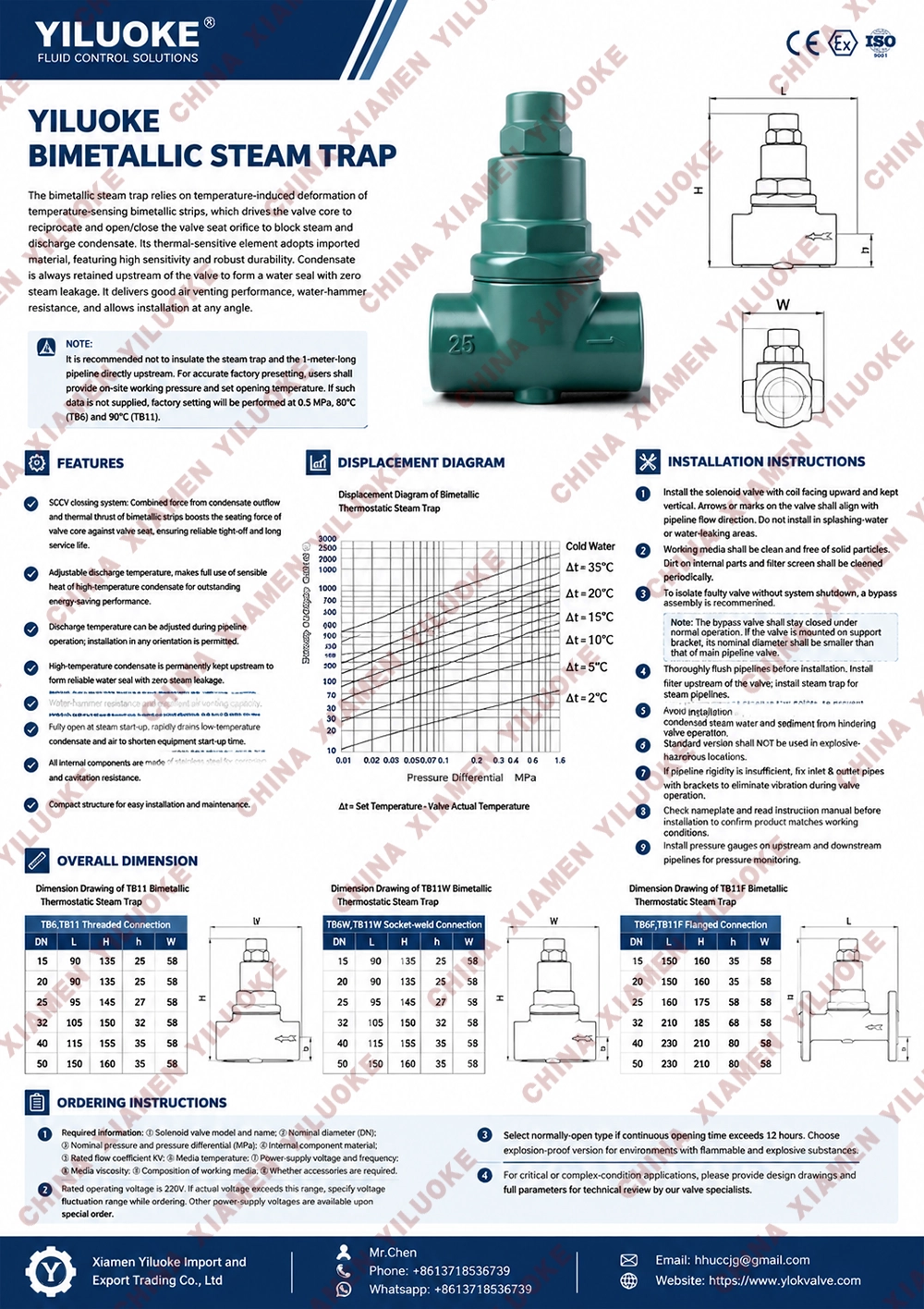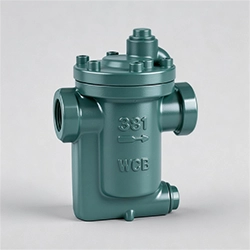


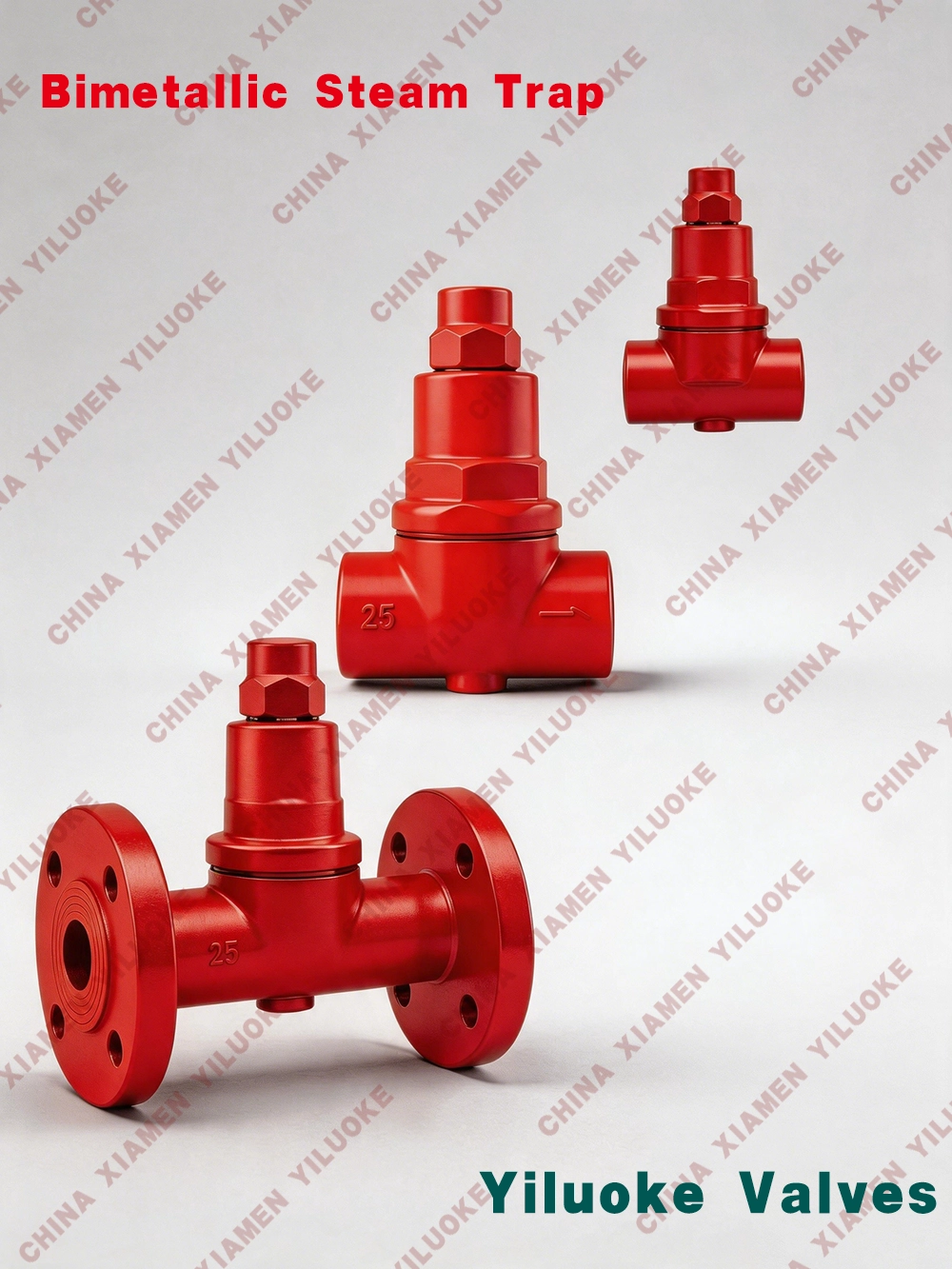
Bimetallic Steam Trap


Bimetallic steam traps are available in different connection types: internal thread connection (CS17H), flange connection (CS47H), socket‑weld connection (CS67H). Adopting bimetallic structure, the seat sealing surface is made of Cr13 series stainless steel, nominal pressure PN16~PN40, and the valve body is made of carbon steel. It is a kind of steam trap mainly used for sensible heat heating applications. It can automatically discharge condensate below the set temperature while keeping condensate above the set temperature at the valve inlet, which plays an important role in improving and saving energy.
Working Principle
The bimetallic steam trap operates by using a bimetallic temperature‑sensing element to drive the valve core for opening and closing the valve. When the equipment is just started, low‑temperature condensate water appears in the pipeline, and the bimetallic strip is flat.
The valve core remains in the open position under the elastic force of the spring. As the temperature of the condensate water gradually rises, the bimetallic temperature‑sensing element begins to bend and deform, pushing the valve core to the closed position.
Before the condensate water reaches the saturation temperature, the steam trap is completely closed. High‑temperature condensate water is always retained in front of the valve, ensuring no steam leakage and excellent energy‑saving effect.
Application Scope
The adjustable bimetallic steam trap is suitable for steam main pipes, steam headers, steam tracing pipelines, radiators, low‑temperature heating tanks, jacketed kettles, etc.
Features and Performance
Newly designed SCCV (Specialized Closure Control Valve) system ensures reliable closure and long service life.
Adjustable discharge temperature enables effective utilization of sensible heat in high‑temperature condensate water, achieving remarkable energy‑saving effect.
Discharge temperature can be adjusted during the operation of the pipe network, and the trap can be installed at any angle.
High‑temperature condensate water is always retained in front of the valve, forming a reliable water seal with no steam leakage.
Excellent water hammer resistance and air venting performance.
No noise during operation, contributing to environmental protection.
The valve is fully open at the initial stage of steam admission, allowing rapid discharge of low‑temperature condensate water and air, significantly shortening the equipment startup time.
All internal components are made of stainless steel, featuring corrosion and cavitation resistance.
Performance Parameters
| Model | PN | Working Pressure/MPa | Applicable Temperature/℃ | Applicable Medium |
| CS17H‑16C CS47H‑16C CS67H‑16C | 16 | 1.6 | ≤425 | Water, Steam |
| CS17H‑25 CS47H‑25 CS67H‑25 | 25 | 2.5 | ≤425 | Water, Steam |
| CS17H‑40 CS47H‑40 CS67H‑40 | 40 | 4.0 | ≤425 | Water, Steam |
Component Materials
| Model | Valve Body Material |
| CS17H‑16C CS47H‑16C CS67H‑16C | WCB |
| CS17H‑25 CS47H‑25 CS67H‑25 | WCB |
| CS17H‑40 CS47H‑40 CS67H‑40 | WCB |
Overall Dimension
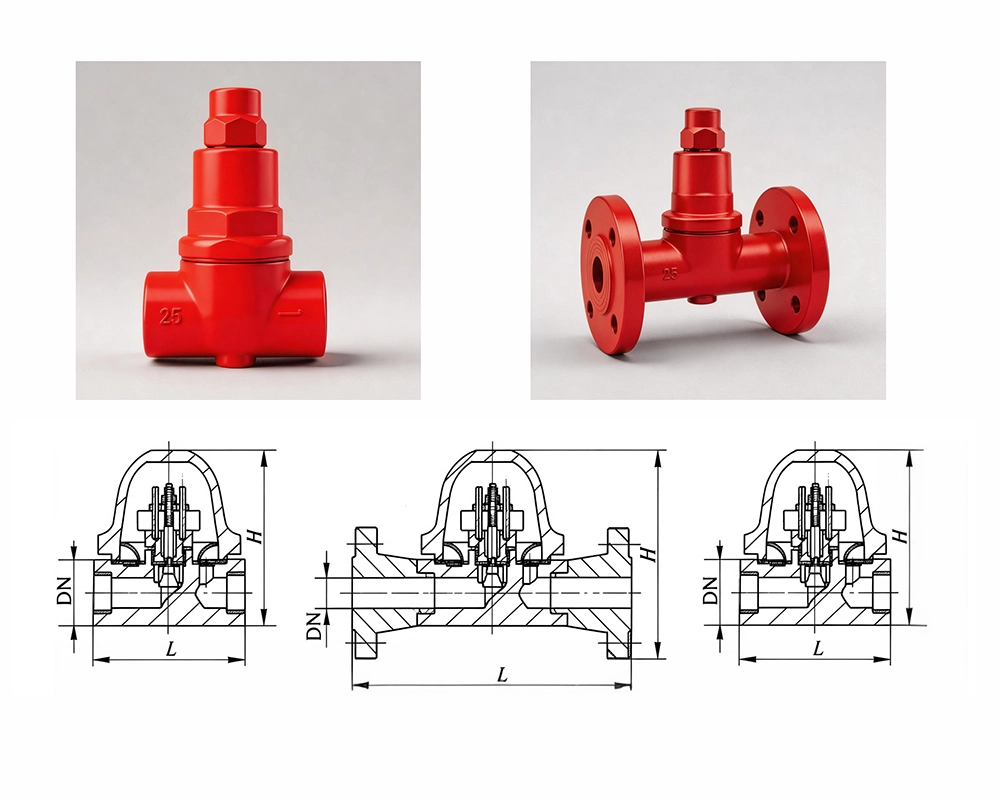
| CS17H‑16C CS17H‑25 CS17H‑40 | CS47H‑16C CS47H‑25 CS47H‑40 | |||||
| DN | 15 | 20 | 25 | DN | 15 | 20 |
| L | 100 | 100 | 100 | D | 165 | 165 |
| H | 116 | 116 | 116 | H | 144 | 148 |
| Weight/kg | 3.5 | 3.5 | 3.6 | Weight/kg | 5.5 | 6.0 |
Discharge Capacity
| Working Pressure Difference/MPa | 0.1 | 0.2 | 0.4 | 0.8 | 1.2 | 1.6 | 2.0 | 2.5 | 3.0 | 3.5 | 4.0 |
| At subcooling 20℃ | 100 | 130 | 160 | 280 | 350 | 400 | 450 | 500 | 530 | 560 | 580 |
| At subcooling 30℃ | 220 | 280 | 380 | 600 | 750 | 800 | 850 | 900 | 1000 | 1100 | 1200 |