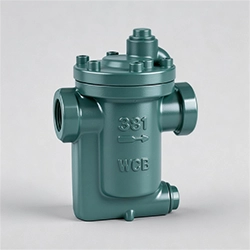


Flanged Thermodynamic Disc Steam Trap


Product Brief of Thermodynamic Disc Steam Trap
The thermodynamic disc steam trap operates on the principle of thermodynamics. It utilizes the distinct thermodynamic properties of steam and condensed water to induce changes in kinetic energy, potential energy, and dynamic-static pressure. These pressure differences act on the valve disc (the actuating component), driving it to open and close, thereby achieving the function of steam blocking and condensate draining. When the condensate discharge rate is low, secondary evaporation occurs. The differences in viscosity, sealing performance, and other characteristics between the re-evaporated steam and the primary steam further actuate the opening and closing of the valve component.
Equipped with a steam or air insulation device, the thermodynamic disc steam trap is not affected by ambient temperature, which reduces its operating frequency and extends service life. It also comes with a built-in filter and blowdown function, featuring sensitive and reliable operation as well as large condensate discharge capacity.
Working Principle of Thermodynamic Disc Steam Trap
The thermodynamic disc steam trap incorporates a valve disc that serves as both a temperature-sensitive element and an actuating component.
Start-up Phase: When the system starts, cooled condensed water accumulates in the pipeline. Driven by the operating pressure, this condensed water pushes the valve disc open and is discharged rapidly.
Valve Closing Phase: After all condensed water is discharged, steam enters the trap. The volume of steam expands instantly, and its flow velocity is much higher than that of condensed water, creating a pressure difference between the upper and lower sides of the valve disc. Under the suction force generated by the high-velocity steam flow, the valve disc closes quickly. When closed, the valve disc is subjected to pressure on both sides. Since the pressure-bearing area on the upper side is larger than that on the lower side, and the pressure inside the trap’s steam chamber is derived from steam pressure, the downward force on the valve disc is greater than the upward force, keeping the valve tightly closed.
Cycle Phase: As the steam inside the trap’s steam chamber cools down and condenses into water, the pressure in the chamber dissipates. The condensed water then pushes the valve disc open again under operating pressure, resuming discharge. This cycle repeats to achieve intermittent drainage.
Product Performance of Thermodynamic Disc Steam Trap
Rational structure, compact size, light weight and easy installation
Freeze-proof, water hammer-resistant and overheat-resistant
Equipped with a stainless steel filter for convenient maintenance
Sensitive operation, excellent sealing performance and long service life
Structural Features of Thermodynamic Disc Steam Trap
Robust structure, light weight and compact size, with a wide operating pressure range and no need for adjustment.
Integrated air vent device for rapid discharge of initial air, ensuring quick system start-up.
Capable of withstanding superheated steam and featuring strong anti-freezing performance; can operate normally regardless of installation orientation.
Product Applications of Thermodynamic Disc Steam Trap
The thermodynamic disc steam trap leverages the different thermodynamic properties of steam and condensed water—specifically, the variations in flow velocity and volume as they pass through the valve orifice—to drive the valve disc to open and close the valve seat orifice, realizing steam blocking and condensate draining. It is mainly applied in steam main pipelines and serves as a critical component to ensure the smooth transportation of steam in such pipelines.
Main Selection Criteria for Thermodynamic Disc Steam Trap
Condensate load (discharge capacity) in kg/h
Operating pressure in MPa
Operating pressure difference in MPa
Valve body material and nominal pressure
Connection type and dimensions
Application scenarios and steam type
Operation and Maintenance of Thermodynamic Disc Steam Trap
Correct installation and regular maintenance are essential to ensure the normal operation of the thermodynamic disc steam trap.
Verify that the valve body material, pressure rating and temperature rating meet the requirements of the working conditions.
Clean the pipeline thoroughly to remove impurities before installation.
Install the steam trap as close as possible to the heating equipment.
Mount the valve at the lowest point of the pipeline, ensuring that the flow direction aligns with the marking on the valve body.
After correct installation, slowly open the valve upstream of the steam trap to allow it to gradually heat up to the normal operating temperature.