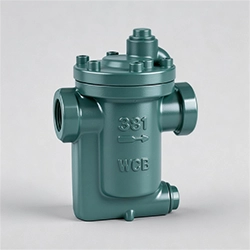


Mechanical Lever Float Steam Trap


1. Overview
The mechanical lever float steam trap operates based on the density difference between steam and condensed water. Changes in the condensed water level cause the float to rise and fall, driving the valve disc to open or close, thereby achieving the function of blocking steam and draining water. This type of steam trap features easy operation and can work effectively with varying condensed water loads, unaffected by sudden changes in operating pressure. It is widely used in steam heating equipment, condensed water recovery systems, and working conditions requiring rapid discharge of condensed water. It automatically, quickly, and continuously drains condensed water, effectively preventing steam leakage and ensuring excellent heating performance.
The lever float steam trap adopts two structural types:
Single valve seat lever float steam trap: Needs to overcome the medium pressure acting on the valve seat, with a small valve seat orifice. It is suitable for low-drainage scenarios such as small equipment, tracing pipelines, and main steam pipes. The valve seat orifice is designed below the condensed water level to form a natural water seal, enabling automatic separation of water and steam. Even without condensed water, the ball-sealed lever keeps the valve disc tightly attached to the valve seat, achieving zero fresh steam leakage and remaining unaffected by fluctuations in condensed water volume and temperature.
Double balanced valve seat lever float steam trap: Utilizes a dual-orifice design where the medium pressure acts equally and oppositely on the two valve seats, offsetting each other. This reduces the opening pressure of the valve core, resulting in ultra-large displacement. During operation, the float rises and falls with the liquid level in the valve chamber, driving the lever to open or close the valve seats. The valve seat orifices form a water seal below the condensed water level, realizing automatic water-steam separation and zero steam leakage. It is not affected by fluctuations in pressure, temperature, or condensed water flow.
2. Working Principle
The mechanical lever float steam trap operates based on the principles of buoyancy and leverage. Changes in liquid level cause the float to rise or fall, which drives the lever to move the valve disc away from or into contact with the valve seat, achieving the functions of opening for drainage and closing to block steam.
When condensed water is generated during equipment startup or operation, it enters the steam trap body, causing the liquid level to rise and the float to ascend accordingly. Through the lever mechanism, the valve disc is opened, and condensed water is rapidly discharged.
When condensed water is completely drained and steam enters the valve body, the liquid level drops due to the significantly lower density of steam compared to water. The float descends, and the lever drives the valve disc to close, preventing steam leakage.
Equipped with a built-in automatic air vent valve, this type of steam trap can automatically discharge non-condensable gases in the system during initial startup, ensuring rapid and efficient equipment commissioning. During operation, if non-condensable gases accumulate in the system (causing a drop in liquid level), the air vent valve automatically opens to release the gases. Once the gases are exhausted and the liquid level returns to normal, the air vent valve closes again. The entire working process is fully automatic without manual intervention. Its unique design offers advantages such as large instantaneous load discharge during startup, tight closing, water hammer resistance, and vibration resistance, enabling stable and reliable operation under various working conditions.
3. Core Features
Zero Steam Leakage: Adopts a lever float mechanism and water seal design to ensure the valve seat is always in a water-sealed state, completely eliminating steam leakage and delivering significant energy-saving effects.
Ultra-Large Displacement: The double balanced valve seat structure offsets the medium pressure acting on the valve seats, resulting in low opening pressure and large water discharge capacity, suitable for high-load working conditions.
Rapid Response: The float directly drives the valve disc with high sensitivity, enabling rapid discharge of condensed water, reducing equipment water accumulation, and improving heating efficiency.
Strong Water Hammer Resistance: Special structural design and material selection effectively resist the impact of water hammer and vibration, extending service life.
Automatic Air Venting: Built-in automatic air vent valve eliminates the need for manual operation, ensuring timely discharge of non-condensable gases in the system and enhancing equipment efficiency.
Wide Operating Condition Adaptability: Unaffected by fluctuations in pressure, temperature, or condensed water flow, capable of stable operation within a wide range of working conditions.
Long Service Life Design: Key components are made of high-strength stainless steel, featuring wear resistance and corrosion resistance, with a service life exceeding 15 years under normal use.
Easy Maintenance: Simple structure and convenient disassembly allow independent replacement of components, reducing maintenance time by 50% and lowering maintenance costs.