


How to Match Electric Actuators with Valves?
Electric Actuators: Matching with Valves and Connection Methods
Electric actuators are mostly matched with valves and applied in automatic control systems. There are many types of electric actuators, which differ in their modes of operation. For example, rotary electric actuators output angular torque, while linear electric actuators output displacement thrust. The type of electric actuator used in a system should be selected according to the operational requirements of the valve.
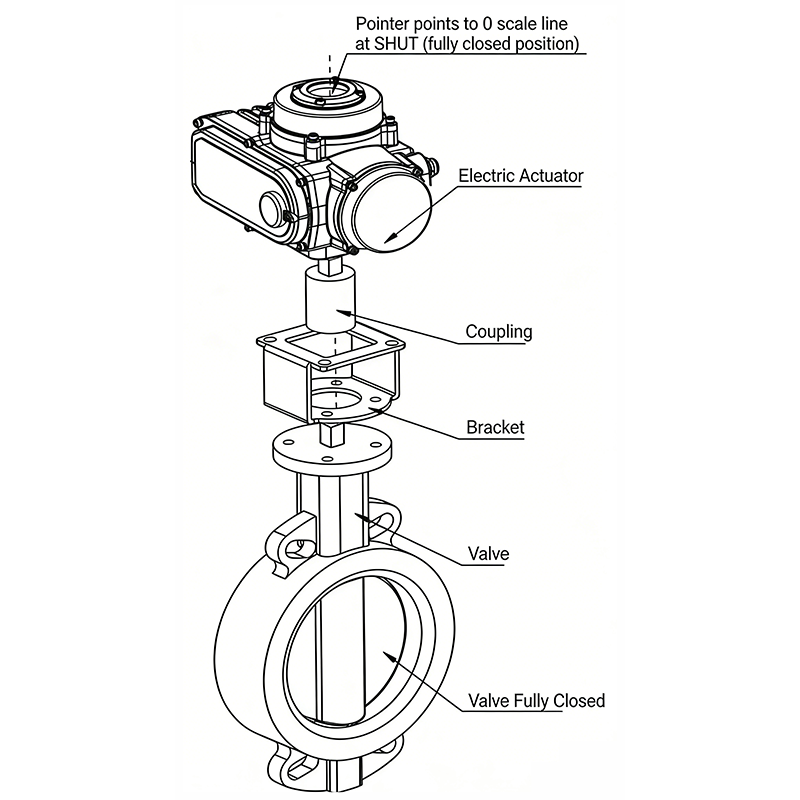
Connection Methods Between Electric Actuators and Valves
1. Flange Connection:
This is the most commonly used connection form in valves. According to the shape of the mating surface, it can be further divided into the following types:
Smooth type: Used for valves with low pressure. It is relatively easy to process.
Concave-convex type: Suitable for high working pressure and can use medium-hard gaskets.
Tongue-and-groove type: Can use gaskets with large plastic deformation, widely used in corrosive media, and has good sealing effect.
Trapezoidal groove type: Uses an elliptical metal ring as the gasket, suitable for valves with working pressure ≥ 64 kg/cm² or high-temperature valves.
Lens type: The gasket is lens-shaped and made of metal. Used for high-pressure valves with working pressure ≥ 100 kg/cm² or high-temperature valves.
O-ring type: This is a relatively new flange connection form developed with the emergence of various rubber O-rings. It has an excellent sealing effect.
2. Threaded Connection:
This is a simple connection method, often used for small valves. It is divided into two cases:
Direct sealing: Internal and external threads directly play a sealing role. To ensure no leakage at the connection, lead oil, linen thread, and PTFE tape are often used for filling; among them, PTFE tape is increasingly widely used. This material has excellent corrosion resistance and sealing effect, is convenient to use and store, and can be completely removed when disassembled because it is a non-adhesive film, which is far superior to lead oil and linen thread.
Indirect sealing: The force of thread tightening is transmitted to the gasket between the two planes, allowing the gasket to play a sealing role.
3. Ferrule Connection:
The connection and sealing principle of ferrule connection is that when the nut is tightened, the ferrule is under pressure, making its cutting edge bite into the outer wall of the pipe. At the same time, the outer conical surface of the ferrule fits closely with the inner conical surface of the joint body under pressure, thus reliably preventing leakage.
The advantages of this connection form are:
Small volume, light weight, simple structure, and easy assembly and disassembly;
Strong connection force, wide application range, and can withstand high pressure (1000 kg/cm²), high temperature (650℃), and impact vibration;
Various materials can be selected, suitable for corrosion prevention;
Low processing precision requirements; convenient for high-altitude installation.
The ferrule connection form has been adopted in some small-diameter valve products in China.
4. Clamp Connection:
This is a quick connection method that only requires two bolts and is suitable for low-pressure valves that need frequent disassembly.
5. Internal Self-tightening Connection:
All the above connection forms use external force to offset the medium pressure to achieve sealing. The following introduces a connection form that uses medium pressure for self-tightening. Its sealing ring is installed at the inner cone. The surface facing the medium forms a certain angle. The medium pressure is transmitted to the inner cone and then to the sealing ring. On the conical surface at a certain angle, two component forces are generated: one is outward parallel to the center line of the valve body, and the other presses against the inner wall of the valve body. The latter component force is the self-tightening force. The higher the medium pressure, the greater the self-tightening force. Therefore, this connection form is suitable for high-pressure valves. Compared with flange connection, it saves a lot of materials and labor, but it also requires a certain pre-tightening force to ensure reliable use when the pressure inside the valve is not high. Valves made using the self-tightening sealing principle are generally high-pressure valves.
There are many other forms of valve connections. For example, some small valves that do not need to be disassembled are welded to the pipeline; some non-metallic valves adopt socket connection, and so on. Valve users should treat them according to specific conditions.
 What Are Creamic Lined Valves?
 How to Select High‑Pressure Ball Valves
 Gas Pressure Regulator Installation and Operation Instructions
 What is a Flowmeter?