


Classification of Self-Operated Control Valves
1. Product Overview
The self-operated control valve requires no external energy supply. It utilizes the inherent energy of the process medium as the power source to drive the actuator, adjust the plug position, and change the pressure difference and flow rate across the valve. This stabilizes the upstream or downstream pressure of the valve automatically.
Featuring sensitive response, reliable tight sealing and minor fluctuation of pressure set point, this valve is widely applied in automatic pressure regulation for gas, liquid and steam media, including pressure reduction, pressure stabilization and pressure relief stabilization working conditions.
This series of valves offers two working types: Type B (downstream pressure regulation for pressure reduction) and Type K (upstream pressure regulation for pressure relief). The adjustable pressure range covers 15~250KPa with segmented regulation, and flexible combinations are available to meet diverse on-site working conditions.
2. Working Principle
The self-operated control valve relies on the medium’s own pressure to adjust the valve opening and realize automatic flow regulation. It is mainly composed of a valve body, valve plug, valve seat, spring and other core components. When the medium flows into the valve, the medium pressure acts on the valve plug, overcomes the spring force and drives the plug to move, thereby changing the valve opening degree.
After setting the target flow value according to process requirements, the valve will automatically adjust the plug position once the actual flow deviates from the set value, keeping the actual flow consistent with the preset parameter. It boasts prominent advantages of no external energy required, fast response speed and high control accuracy.
3. Flow Control Mode
Self-acting control valves are divided into two control types: direct-acting and indirect-acting.
Direct-acting Type: Adjusts the valve opening directly by the self-pressure of the process medium, realizing passive automatic regulation without auxiliary equipment.
Indirect-acting Type: Matches with an external control system to drive valve operation and achieve precise automatic flow regulation.
Both control modes support fast and accurate flow control to stabilize process parameters.
In practical industrial applications, the valve can cooperate with sensors and controllers. Sensors detect real-time medium parameters such as flow and pressure and transmit signals to the controller. The controller outputs control signals according to the deviation between set values and actual values to adjust the valve plug position, realizing closed-loop automatic regulation, stabilizing production process parameters and improving production efficiency and product quality.
4. Standard Specifications
Parameter Item | Specification |
Valve Body Type | Straight-through cast body |
Plug Type | Quick-opening plug |
Nominal Diameter | DN20~DN300, NPS3/4〞~12〞 |
Nominal Pressure | PN16~PN64, CLASS150LB~300LB |
Connection Type | Flange: FF, RF, RTJ |
Bonnet Type | Bolt compression type |
Packing | V-type PTFE |
Gasket | Metal graphite composite gasket |
Actuator Type | Diaphragm self-operated type, Piston self-operated type |
5. Product Classification & Working Principle
Self-operated control valves are mainly divided into four categories: self-operated pressure control valves, self-operated differential pressure control valves, self-operated temperature control valves, and self-operated flow control valves. The detailed working principles of each type are described as follows:
5.1 Self-Operated Pressure Control Valve (Downstream Pressure Control)
The upstream medium pressure P1 passes through the throttling position of the plug and seat and turns into downstream pressure P2. The downstream pressure P2 is transmitted into the lower diaphragm chamber of the actuator through the control pipeline and acts on the top disc. The force generated balances the spring reaction force, so as to determine the relative position of the plug and seat and stabilize the downstream pressure.
When the downstream pressure P2 rises, the acting force on the top disc increases accordingly. The disc force exceeds the spring force, pushing the plug toward the seat to reduce the flow area. The flow resistance increases and the downstream pressure P2 drops back to the set rated value. When the downstream pressure P2 decreases, the movement direction reverses to maintain stable downstream pressure.
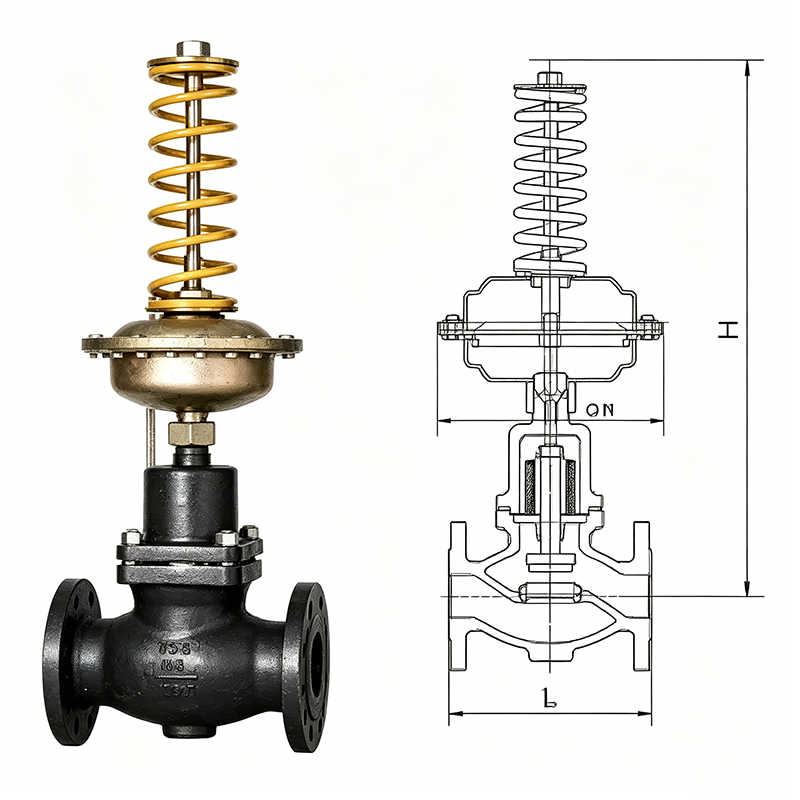
5.2 Self-Operated Pressure Control Valve (Upstream Pressure Control)
The medium upstream pressure P1 enters the upper diaphragm chamber of the actuator through the control pipeline and acts on the top disc. The acting force balances the spring reaction force to adjust and stabilize the upstream pressure.
When the upstream pressure P1 rises, the force on the top disc increases and overcomes the spring force, driving the plug away from the seat. The flow area increases and the flow resistance decreases, lowering the upstream pressure P1 to the preset value. When the upstream pressure P1 drops, the valve acts in the opposite direction to keep the upstream pressure stable.
5.3 Self-Operated Temperature Control Valve (Heating Type)
This valve operates based on the incompressibility and thermal expansion & contraction principle of liquid medium.
For heating-type self-operated temperature control valves: when the measured temperature is lower than the set value, the liquid inside the temperature bulb contracts, reducing the thrust on the actuator rod. The plug assembly opens under spring force and increases the flow of heating media such as steam and hot oil to raise the target temperature.
When the temperature reaches the rated set value, the valve gradually closes to stop heating. When the temperature drops, the valve opens again to replenish the heating medium. This continuous cycle keeps the controlled temperature within a stable range. The valve opening degree changes automatically according to the deviation between the actual temperature and the set temperature.
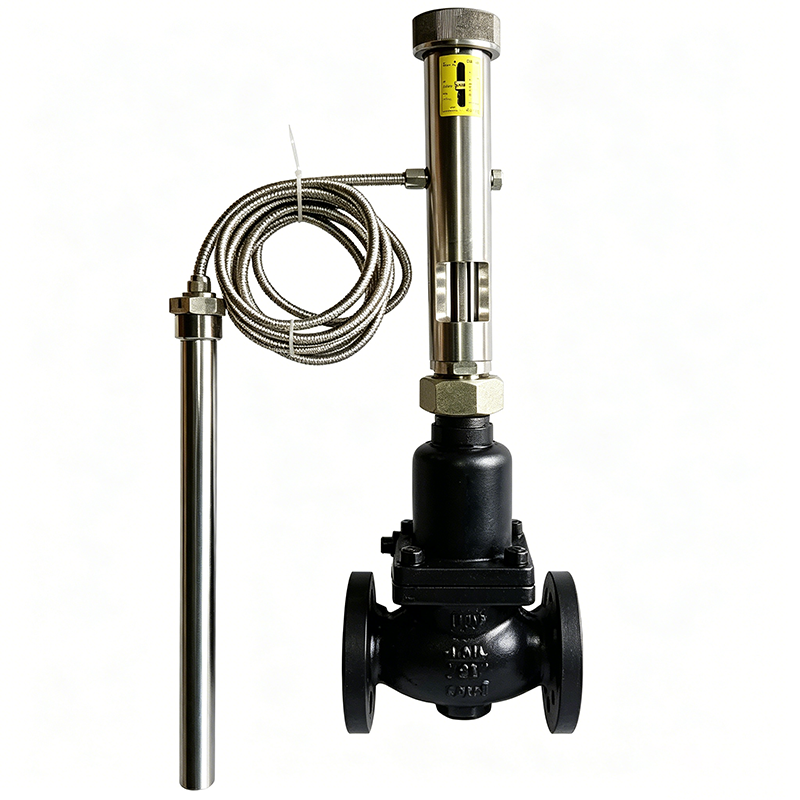
5.4 Self-Operated Temperature Control Valve (Cooling Type)
The working principle of the cooling-type self-operated temperature control valve is similar to the heating type. The only difference is its opposite opening and closing logic under actuator and spring force. The valve controls the flow of cooling media and is widely used for temperature stabilization in cooling and refrigeration systems.
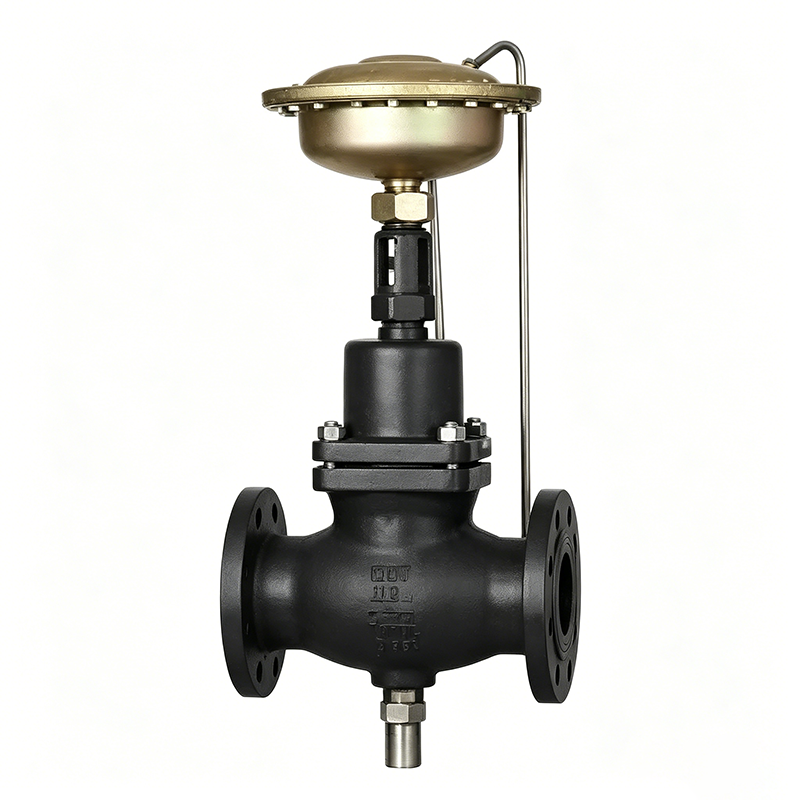
5.5 Self-Operated Flow Control Valve
After the medium enters the valve, the upstream pressure P1 is guided into the lower diaphragm chamber via the control pipeline. The pressure Ps after throttling enters the upper diaphragm chamber. The effective pressure difference △Ps = P1 - Ps determines the valve flow rate.
The thrust difference generated by P1 and Ps acting on the diaphragm balances the spring force and controls the relative position of the plug and seat. When the pipeline flow increases, △Ps rises, pushing the plug toward the seat and reducing the flow area. The throttled pressure Ps increases and forms a new force balance with the spring force and upstream pressure, finally stabilizing the flow rate at the preset value and realizing automatic flow regulation.
Parameter Item | Specification |
Valve Body Type | Straight-through cast body |
Plug Type | Quick-opening plug |
Nominal Diameter | DN20~DN300, NPS3/4〞~12〞 |
Nominal Pressure | PN16~PN64, CLASS150LB~300LB |
Connection Type | Flange: FF, RF, RTJ |
Bonnet Type | Bolt compression type |
Packing | V-type PTFE |
Gasket | Metal graphite composite gasket |
Actuator Type | Diaphragm self-operated type, Piston self-operated type |
 What Are Creamic Lined Valves?
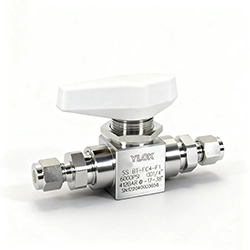 How to Select High‑Pressure Ball Valves
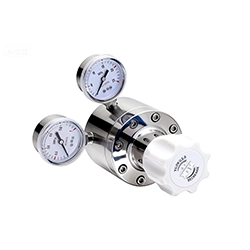 Gas Pressure Regulator Installation and Operation Instructions
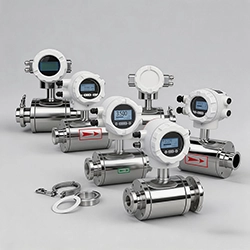 What is a Flowmeter?