


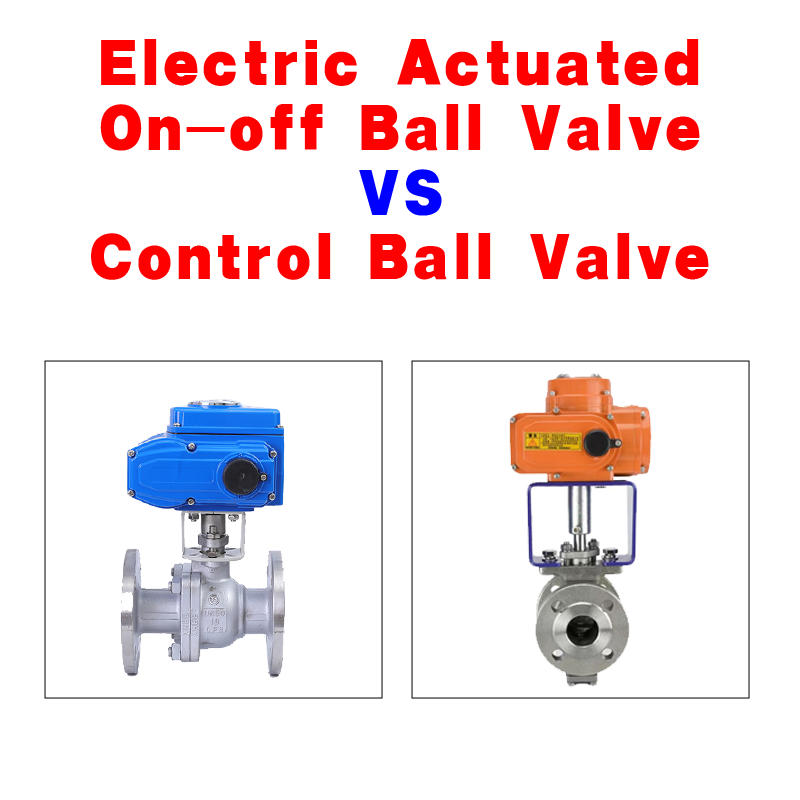
Electric Actuated On-Off Ball Valves VS Control Ball Valves
Differences Between Electric Actuated On-Off Ball Valves and Electric Actuated Control Ball Valves
What are the differences between electric actuated on-off ball valves and electric actuated control ball valves?
Electric actuated on-off ball valves are generally used for two-position on-off cut-off, with two positions: fully open and fully closed. Their function is to open or close to conduct and cut off the working medium inside. There are no special requirements for flow characteristics, but the requirements for on-off speed and leakage are higher than those of control valves.
Electric actuated control ball valves are mainly used to regulate parameters such as the flow rate, pressure and liquid level of the medium. They have high requirements for flow characteristics during the whole process from opening to closing; the requirements for the stability of the opening degree between opening and closing are higher than those of on-off valves.
On-off electric actuated ball valves realize the opening and closing of the ball valve by energizing. After energization, the valve opens slowly until it is fully open, and closes slowly until it is fully closed. It is not possible to adjust the opening degree of the ball valve arbitrarily.
To adjust the opening degree of the ball valve, an electric actuated control ball valve must be used, which controls the opening degree of the ball valve through analog quantity control. The general analog signal is 4-20mA.
Electric actuated control ball valves are equipped with electric actuated control actuators, which have a control module inside. The valve has no response when the module is connected to the power supply; a current signal (4-20mA, a function customized before leaving the factory) is required to open the valve. 4mA corresponds to the fully closed position of the valve, 20mA corresponds to the fully open position, and 8mA corresponds to the middle position (50%). (Note: There are various models of electric actuator controllers, and the working mode and method must be operated correctly according to the instructions provided by the manufacturer.)
Frequently Asked Questions About Electric Actuated On-Off Ball Valves and Electric Actuated Control Ball Valves
1. What state is the ball valve in if the power is cut off after the on-off electric actuated ball valve is fully open/closed?
For the corresponding on-off electric actuated ball valve, if the power is cut off after the valve is fully open/closed, the ball valve will remain in its original position, that is, keep the fully open or fully closed state. Of course, if the power is cut off during the opening or closing process of the valve, the valve will also stay in its original position.
2. Is it necessary to cut off the power supply when the on-off electric actuated ball valve is in the fully open/closed state?
It is not necessary to cut off the power supply. Keeping the power supply connected can also keep the motor in a dry state.
3. Will the electric actuated control ball valve open when connected to AC220V alternating current?
The electric actuated control ball valve will not open only by connecting to the power supply, that is, there is no feedback.
4. Where does the input signal of the electric actuated control ball valve come from?
The control module equipped with the electric actuated control ball valve actuator uses AC220V single-phase alternating current as the power supply, and the input signal is generally DC4-20mA, which comes from systems such as PLC and DCS. The valve will open only when both conditions of connecting the AC220V power supply and providing the input signal are met.
5. What state will the valve be in if the input signal of the electric actuated control ball valve is lost?
If the input signal is lost, the actuator will make the valve either stay in its original position, move to the fully open position, or move to the fully closed position according to the DIP switch selection set by the user on the module in advance.
Structural and Application Differences Between Electric Actuated On-Off Ball Valves and Electric Actuated Control Ball Valves
1. Electric Actuated On-Off Ball Valves (Open-Loop Control)
Electric actuated on-off ball valves generally realize the on-off control of the valve; the valve is either in the fully open position or the fully closed position. Such valves do not need to accurately control the medium flow rate.
It is particularly worth mentioning that electric actuated on-off actuators can also be divided into split structure and integrated structure according to different structural forms. This must be specified during selection; otherwise, mismatches such as conflicts with the control system during on-site installation often occur.
a) Split structure (usually called ordinary type): The control unit is separated from the electric actuator. The electric actuator cannot control the valve independently and must be equipped with an additional control unit to realize control. Generally, an external controller or control cabinet is used for matching.
The disadvantages of this structure are that it is not convenient for the overall installation of the system, increases wiring and installation costs, and is prone to failures. When a failure occurs, it is not convenient for diagnosis and maintenance, and the cost performance is not ideal.
b) Integrated structure (usually called integral type): The control unit and the electric actuator are encapsulated as a whole. On-site operation can be realized without an external control unit, and remote operation can be performed only by outputting relevant control information.
The advantages of this structure are convenient overall installation of the system, reduced wiring and installation costs, and easy diagnosis and troubleshooting. However, traditional integrated structure products also have many imperfections, so intelligent electric actuators have been developed. Details about intelligent electric actuators will be explained later.
2. Electric Actuated Control Ball Valves (Closed-Loop Control)
Electric actuated control ball valves not only have the functions of the integrated on-off structure but also can accurately control the electric valve, thereby accurately regulating the medium flow rate. Due to space limitations, its working principle will not be explained in detail here.
The following is a brief description of the parameters that need to be specified when selecting an electric actuated control actuator.
a) Type of control signal (current, voltage)
The control signal of the electric actuated control actuator is generally a current signal (4~20mA, 0~10mA) or a voltage signal (0~5V, 1~5V). The type and parameters of the control signal must be clarified during selection.
b) Working form (electrically open type, electrically closed type)
The working mode of the electric actuated control actuator is generally electrically open type (taking 4~20mA control as an example, the electrically open type means that the 4mA signal corresponds to the valve closed, and 20mA corresponds to the valve open). The other is the electrically closed type (taking 4-20mA control as an example, the electrically closed type means that the 4mA signal corresponds to the valve open, and 20mA corresponds to the valve closed). Generally, the working form needs to be clarified during selection.
c) Signal loss protection
Signal loss protection means that when the control signal is lost due to line faults, the electric actuator will control the valve to open and close to the set protection value. Common protection values are three situations: fully open, fully closed, and keeping the original position, which are not easy to modify after leaving the factory. The intelligent electric actuator can be flexibly modified through on-site settings, and any position (0~100%) can be set as the protection value.
 What Are Creamic Lined Valves?
 How to Select High‑Pressure Ball Valves
 Gas Pressure Regulator Installation and Operation Instructions
 What is a Flowmeter?