


What Are Electric Actuated Globe Valves?
Electric Actuated Globe Valves: Composition, Advantages and Classification
An electric actuated globe valve consists of two parts: an electric actuator and a globe valve. Its closing part is a valve disc, which rotates around the center line of the valve body to achieve opening and closing.
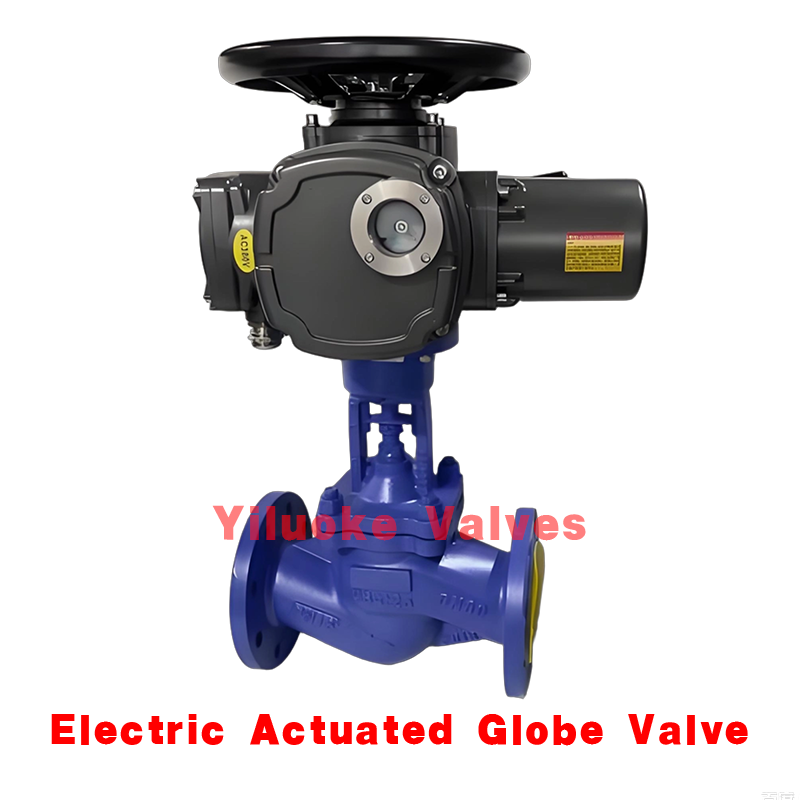
Advantages of Electric Actuated Globe Valves
Simple structure, relatively convenient to manufacture and maintain.
Small working stroke and short opening and closing time.
Good sealing performance, small friction between sealing surfaces, and long service life.
The structural forms of the globe valve body include straight-through type, angle type and Y-type. The straight-through type is the most common structure, but it has the largest fluid resistance. The angle type has smaller fluid resistance and is mostly used for fluids containing solid particles or high viscosity. The Y-type valve body is mostly forged and is suitable for globe valves with small diameter and high pressure.
During the opening and closing process, the friction of the sealing surface is smaller than that of the gate valve, and it is wear-resistant.
There is usually only one sealing surface, which has good manufacturing technology and is easy to maintain.
The electric actuator is convenient for operation.
Classification of Electric Actuated Globe Valves
According to the Flow Direction
Straight-through globe valve;
Angle globe valve;
In the angle or Y-type globe valve, the flow channel of the valve body forms an oblique line with the main flow channel. This results in less damage to the flow state than the conventional globe valve, and thus the pressure loss through the valve is correspondingly reduced.
Y-type globe valve;
In the Y-type globe valve, the fluid only needs to change direction once, so that the pressure drop through this valve is smaller than that of the globe valve with conventional structure.
Plunger globe valve;
This type of globe valve is a variant of the conventional globe valve. In this valve, the valve disc and valve seat are usually designed based on the plunger principle. The valve disc is ground into a plunger and connected to the valve stem, and the sealing is achieved by two elastic sealing rings sleeved on the plunger. The two elastic sealing rings are separated by a collar, and the sealing rings around the plunger are pressed tightly by the load applied to the valve cover by the valve cover nut. The elastic sealing rings can be replaced and can be made of various materials. This valve is mainly used for "opening" or "closing", but it can also be used for regulating flow with a specially designed plunger or a special collar.
 What Are Creamic Lined Valves?
 How to Select High‑Pressure Ball Valves
 Gas Pressure Regulator Installation and Operation Instructions
 What is a Flowmeter?