


What are Vacuum Valves?
Vacuum Valves: Overview, Classification, Features, Advantages & Disadvantages
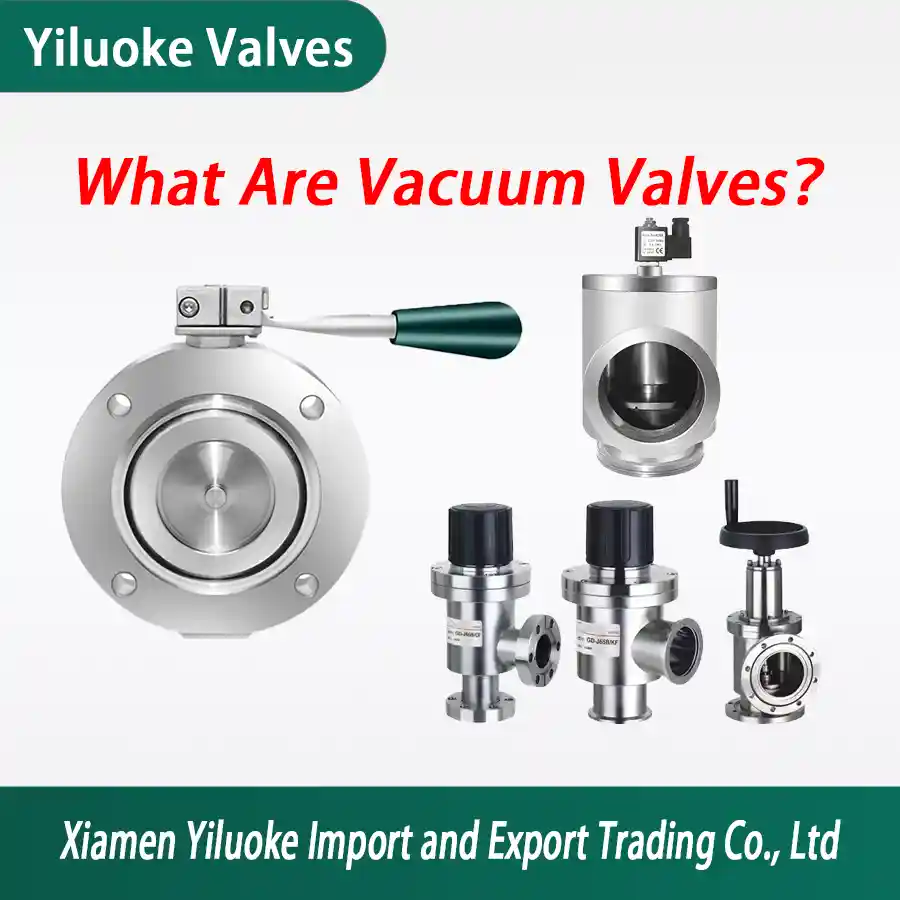
Vacuum valves are components in vacuum systems used to change gas flow direction, adjust gas flow rate, and cut off or connect pipelines.
Overview
Vacuum valves, high vacuum valves, and ultra-high vacuum valves can be grouped by medium pressure, with distinct classification standards and application scenarios. They are widely used in various industrial fields due to their flexible control capabilities and reliable performance.
Classification by Medium Pressure
Low Vacuum Valves: Medium pressure p = 760 ~ 1 mmHg
Medium Vacuum Valves: p = 1×10⁻³ mmHg
High Vacuum Valves: p = 1×10⁻⁴ ~ 1×10⁻⁷ mmHg
Ultra-High Vacuum Valves: p ≤ 1×10⁻⁸ mmHg
Types of Vacuum Valves
Vacuum Ball Valves, Vacuum Butterfly Valves, Vacuum Gate Valves, Vacuum Diaphragm Valves, Vacuum Globe Valves, Vacuum Regulating Valves, Vacuum Gate Valves, Vacuum Flap Valves, Vacuum Inflation Valves, etc.
Key Features
Simple structure, high reliability, excellent sealing performance, and strong wear resistance
High sensitivity, fast response, and easy operation
Enables continuous regulation and control of various vacuum applications
Supports automatic control for convenience and efficiency
Achieves bidirectional control, safe and reliable
Multifunctional with good flexibility
Advantages of Vacuum Valves
Simple structure, easy installation, flexible operation, durable and reliable, excellent sealing performance, and low loss
Valve cores can be made of different materials to meet various working condition requirements
High action precision ensures accurate control
Valve bodies are made of corrosion-resistant materials, suitable for use in various corrosive media
Control systems can be adjusted according to actual needs for optimal control performance
Disadvantages of Vacuum Valves
Although the structure is simple, performance is greatly affected by ambient temperature
High operating noise; sealing performance is not ideal under certain pressure conditions
Sealing performance decreases with increasing temperature, and temperature has a significant impact
Sealing performance is greatly affected by water vapor; excessive water vapor will impair valve performance
Low control precision, not suitable for occasions requiring high control accuracy
Weak corrosion resistance, cannot be used in high-corrosive medium environments
Short service life, generally only 2-3 years; prolonged use will affect performance
High requirements for design and manufacturing technology, resulting in relatively high production costs
How Are Vacuum Valves Classified?
1. Working Pressure
Based on working pressure, vacuum valves are classified into low vacuum valves, high vacuum valves, and ultra-high vacuum valves:
Low vacuum valves: Suitable for low vacuum conditions
High vacuum valves & ultra-high vacuum valves: Suitable for higher vacuum environments, with better sealing performance and lower leak rates
2. Sealing Material
According to dynamic sealing materials, vacuum valves are divided into metal-sealed and non-metal-sealed valves:
Metal-sealed valves: Adopt metal materials (e.g., metal bellows) for shaft seals, featuring low leak rates, suitable for ultra-high vacuum conditions
Non-metal-sealed valves: Use materials such as O-shaped rubber rings, with higher leak rates, suitable for high vacuum conditions with low vacuum requirements
3. Body Material
Vacuum valves can be classified by body material, with common options including:
Stainless Steel
Carbon Steel
Aluminum Alloy
The choice of material depends on specific application environments and requirements.
4. Structural Characteristics
Based on structural features, vacuum valves include:
Butterfly Valves, Ball Valves, Diaphragm Valves, Angle Valves, Gate Valves, Straight-Through Valves, Three-Way Valves, etc.
Each type is suitable for different application scenarios:
Butterfly Valves: Ideal for quick fluid cutoff
Diaphragm Valves: Suitable for occasions requiring high fluid sealing performance
5. Transmission Principle
According to transmission principle, vacuum valves are classified into:
Manual Valves
Pneumatic Valves
Electric Valves
Solenoid Valves
Pneumatic valves: Usually use electromagnetic pilot control for cylinder actuation
Electric valves: Can be operated manually or electrically; switch to manual mode during power outages
 What Are Creamic Lined Valves?
 How to Select High‑Pressure Ball Valves
 Gas Pressure Regulator Installation and Operation Instructions
 What is a Flowmeter?