


Bellows Sealed Globe Valves For Ammonia Special Service
Ammonia Service Bellows Sealed Globe Valves: Introduction, Working Principle & Test Methods
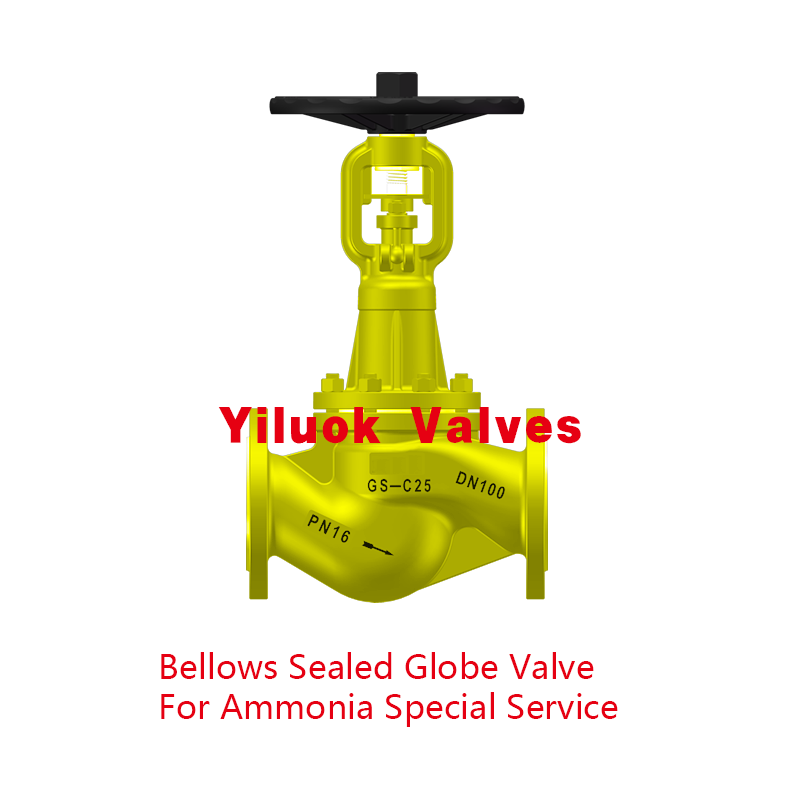
Ammonia Service Bellows Sealed Globe Valves feature a plug-shaped disc with a flat or conical sealing surface. The disc moves linearly along the centerline of the fluid flow. The valve stem adopts a rising rotary stem design—the handwheel rotates and elevates together with the stem, and the nut is mounted on the valve body. Globe valves are only suitable for fully open and fully closed operations.
Ammonia Service Bellows Sealed Globe Valves are required to achieve leak-free performance on the sealing surface through forced sealing, and their structure shall meet fire safety requirements. The packing is made of PTFE, ensuring reliable sealing and zero external leakage. The sealing pair adopts a soft-seal design with PTFE or nylon paired with the valve body material, delivering dependable sealing performance. These valves are suitable as on-off devices in ammonia storage tank and liquefied petroleum gas pipeline systems, and can also be applied to other pipelines with a maximum medium temperature of ≤80℃.
Working Principle of Ammonia Service Bellows Sealed Globe Valves
The stem axis of an Ammonia Service Bellows Globe Valve is perpendicular to the sealing surface of the valve seat. The opening or closing stroke of the stem is relatively short, and the valve provides highly reliable shut-off action, making it ideal for medium isolation, regulation, and throttling applications.
During the closing process of an imported ammonia service bellows globe valve (starting from the fully open position), the descending disc creates a pressure difference across its front and rear sides, which resists the disc's downward movement. This resistance increases rapidly as the disc descends. When the globe valve is fully closed, the pressure difference across the disc equals the working pressure of the medium, resulting in the maximum resistance. Combined with the forced sealing force, the operating force required at the moment of valve closure increases sharply. During the opening process, the thrust generated by the medium pressure or the pressure difference across the disc helps to open the valve. It should be noted that the torque required at the moment of valve opening may exceed that required for closing, as it needs to overcome relatively high static friction at this stage.
Test Methods for Ammonia Service Bellows Sealed Globe Valves
Pressure Test: The shell strength and sealing performance tests of ammonia service globe valves shall comply with the provisions of JB/T 9092.
Valve Body Wall Thickness Measurement: Measure the wall thickness of the valve body's flow passage, middle cavity, and bonnet using a thickness gauge or special caliper.
Valve Stem Diameter Measurement: Measure the diameter of the stem section in contact with the packing and the diameter of the stem thread using a vernier caliper.
Material Composition Analysis: Take samples from the base material of the valve body, bonnet, and disc. For drill chip sampling, the sampling depth shall be at least 6.5mm below the surface.
Valve Body Mechanical Property Test: Conduct the test on test bars that are heat-treated in the same batch and furnace as the valve body, in accordance with the method specified in GB/T 228.
Static Pressure Life Test: Perform the life test using dry air under the rated pressure difference, following the method specified in JB/T 8859.
Valve Body Marking Inspection: Visually inspect the content of the cast or stamped markings on the surface of imported ammonia service valves (ammonia service globe valves).
Nameplate Content Inspection: Visually inspect the content of the stamped markings on the nameplate of the valve (ammonia gas globe valve).
 What Are Creamic Lined Valves?
 How to Select High‑Pressure Ball Valves
 Gas Pressure Regulator Installation and Operation Instructions
 What is a Flowmeter?