


What Are Ammonia Service Valves?
Ammonia Service Valves
Ammonia is a type of special fluid medium. Valves used for conveying ammonia are called ammonia service valves. These valves not only adopt special sealing materials and structural designs, but also feature stable sealing performance, safe and reliable operation, strong corrosion resistance, zero internal and external medium leakage, and easy operation. Their sealing performance, maintainability and safety are all superior to those of ordinary valves.
Ammonia service valves successfully solve the problems of ammonia-induced shell corrosion and perforation as well as high sealing requirements. They are particularly suitable for the transportation of chlorine and liquid chlorine pipelines in the chemical industry, and can meet the requirements of long-term reliable use. Ammonia-specific valves effectively address the drawbacks of ordinary valves used in chemical pipelines, such as poor corrosion resistance, easy shell perforation, inferior sealing performance and high leakage risk. They are especially applicable to the transportation of chlorine and liquid chlorine pipelines in the chemical industry, satisfying the demand for long-term stable operation.
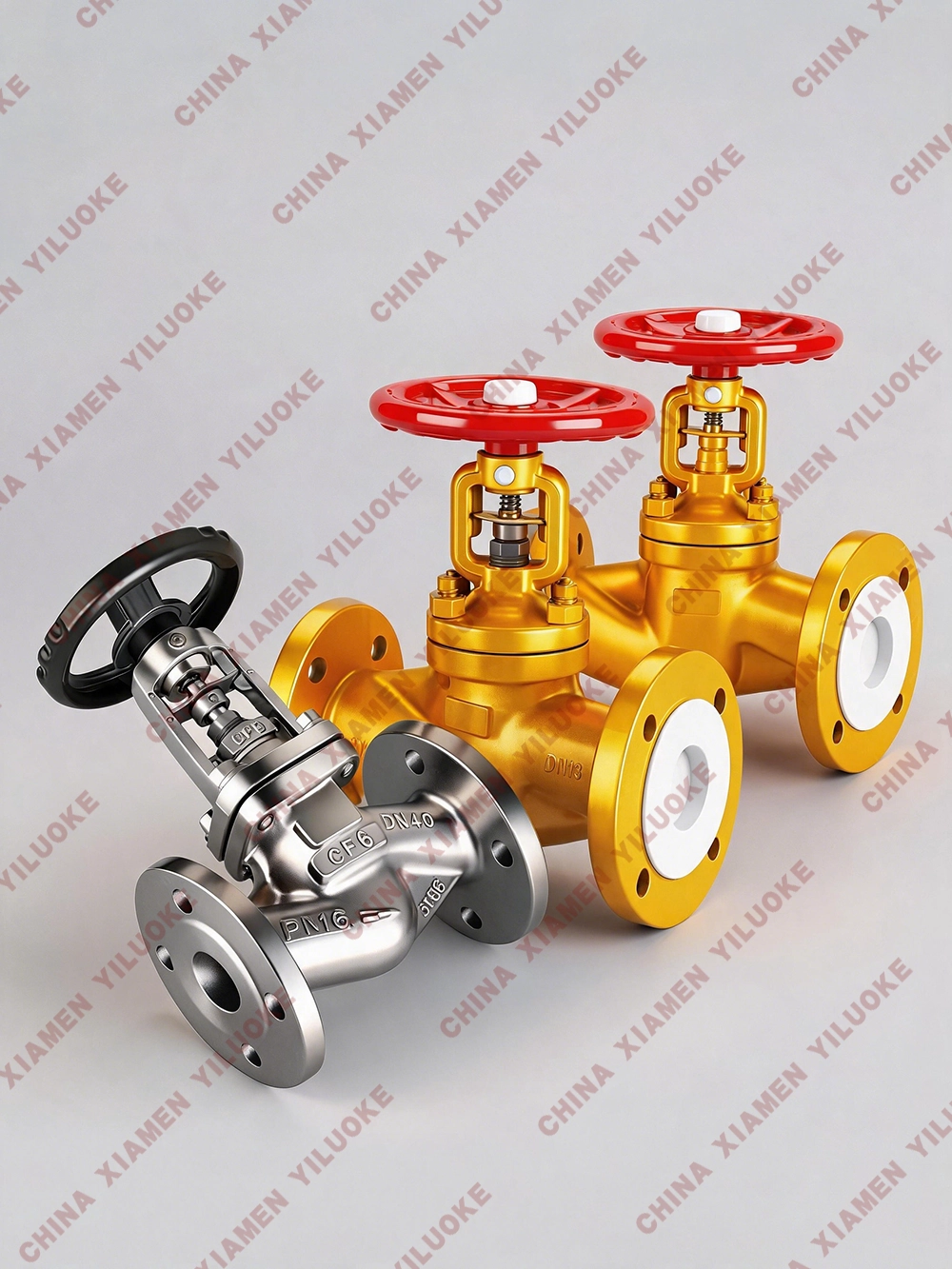
Structural Features of Ammonia Service Valves
a. As valves for medium isolation and connection, imported ammonia service globe valves are widely adopted for ammonia handling. Aiming at overcoming the shortcomings of ordinary valves, such as poor corrosion resistance and easy shell perforation, ammonia-specific valves are made of corrosion-resistant steel for the valve body according to the specific properties of the medium. This material can resist corrosion from ammonia and liquid ammonia, and adapt to low temperatures down to -40℃, maximizing the satisfaction of working condition requirements.
b. Ammonia reacts chemically with copper and copper-containing materials. Therefore, all components of imported ammonia service valves shall not use copper-based materials.
c. The sealing surfaces are all made of Babbitt metal. The structural characteristic of Babbitt metal is that hard phase particles are uniformly distributed on a soft phase matrix. The soft phase matrix endows the alloy with excellent embedability, conformability and anti-seizure performance. After running-in, the soft matrix becomes concave while the hard particles protrude outward, forming tiny gaps between the sliding surfaces. These gaps serve as oil storage spaces and lubricating oil channels, which are beneficial to reducing friction. The protruding hard particles play a supporting role, which is conducive to load bearing. Ammonia is prone to leakage, while Babbitt metal is relatively soft and deformable, enabling the valve core and valve seat to fit closely and ensuring excellent sealing performance.
d. The sealing pair of ammonia-specific valves adopts a ball-and-plane matching structure with automatic sealing compensation, achieving double insurance effects. It features stable sealing performance and no adhesive wear, effectively solving the problems of poor sealing performance and high leakage risk of ordinary valves used in chemical pipelines.
e. The middle flange of the product adopts a tongue-and-groove sealing structure, which ensures absolute reliable sealing of the middle flange even when the pipeline pressure fluctuates.
f. The upper sealing device adopts multi-stage PTFE sealing materials to form a combined seal. This design ensures no medium leakage from the stuffing box during the service life of the valve, eliminating the possibility of medium leakage from the stuffing box—a weak point of ordinary valves—which may even lead to accidents.
g. Although J41B valves are more suitable for ammonia service and have better sealing performance than J41Y valves, the following points must be noted during actual operation: the sealing surfaces of J41B valves are softer than those of J41Y valves. Never use an F-type wrench to close them excessively tightly. Manual closure is recommended as far as possible to prevent damage to the sealing surfaces caused by excessive force with the wrench.
Installation, Operation and Maintenance of Ammonia Service Valves
1. Installation
(1) Globe valves operated by handwheel or handle can be installed at any position on the pipeline.
(2) Handwheels, handles and transmission mechanisms shall not be used for hoisting.
(3) The flow direction of the medium shall be consistent with the arrow marked on the valve body.
2. Operation Method
During operation, open the main cylinder valve first, then turn the low-pressure adjusting screw clockwise. It compresses the main spring and drives the diaphragm, spring pad and push rod to open the valve plug. High-pressure inlet gas passes through throttling and pressure reduction from the high-pressure chamber into the low-pressure chamber, and flows to the working system through the outlet. Rotate the adjusting screw to change the opening stroke of the valve plug, adjust gas throughput and reach the required pressure.
All ammonia service globe valves are equipped with safety valves. It is a protective device for safe operation of ammonia pressure regulators, and also serves as an alarm device when faults occur. If the outlet pressure rises automatically beyond the allowable limit due to damaged valve plug gasket or other failures, the safety valve will automatically open to exhaust gas.
3. Maintenance
1. Before installation, confirm that the connection specification of the ammonia pressure regulator matches the connector of the system. Ammonia service globe valves adopt hemispherical connection; tighten the nut to achieve full fitting between two surfaces. Keep both hemispherical surfaces clean to guarantee good air tightness. High-pressure gas can be used to blow off dust before installation. PTFE gaskets can be adopted when necessary.
2. Ammonia service globe valves must be kept away from grease to avoid fire hazards.
3. After shutdown, exhaust all residual gas inside the regulator, then loosen the adjusting screw to avoid permanent deformation of elastic components under long-term compression.
4. Ammonia service globe valves shall avoid impact and vibration, and shall not contact corrosive substances.
Classification of Ammonia Valves
Category 1: Manual Valves, manually controlled valves: ammonia globe valve, ammonia ball valve, ammonia needle valve, ammonia throttle valve, ammonia regulating valve,ammonia solenoid valve.
Category 2: Automatic Valves, closed by built-in spring driven by pipeline fluid, liquid, gas, steam or hydraulic pressure: ammonia breakaway valve, ammonia flow limiting valve, ammonia check valve, ammonia safety valve, ammonia pressure reducing valve.
Category 3: Actuated Valves, controlled by electric, pneumatic, hydraulic or electro-hydraulic power: emergency shut-off valve, electric shut-off valve, pneumatic shut-off valve, hydraulic shut-off valve, electric ball valve, pneumatic valve, electric control valve, pneumatic control valve, pneumatic globe valve, electric globe valve.
The ammonia globe valve, also known as liquid ammonia globe valve, is a widely adopted valve type. It gains popularity for low friction between sealing faces during opening and closing, long service life, small opening height, easy manufacturing and convenient maintenance. It is applicable to both medium-low pressure and high-pressure working conditions.
Ammonia ball valve, also called liquid ammonia ball valve, opens and closes by rotating the ball element. It is lightweight, compact, available in large nominal sizes, reliable in sealing and simple in structure for easy maintenance. The sealing surface and ball are always sealed to resist medium corrosion, widely used in various industries.
Ammonia needle valve is applied for ammonia pressure gauge backflush pipelines. Its trim is a sharp conical body inserted into the seat like a needle. Compared with other valves, needle valves withstand higher pressure with superior sealing performance, normally used for sealing low-flow, high-pressure gas or liquid media. Needle valves are ideal for pressure gauge installation. Common connection forms include female thread, male thread and welding ends.
Ammonia throttle valve / ammonia regulating valve shares a similar structure with liquid ammonia globe valve. The disc adopts tapered design surfaced with hardfacing alloy, realizing throttling and flow regulation functions.
Selection Guidelines for Ammonia Valves
1. Clarify the application of the valve on equipment or devices, confirm working conditions, applicable medium, working pressure and temperature.
2. Confirm nominal diameter and connection type of matching pipelines: flange, thread, welding, etc.
3. Determine operation mode: manual, electric, electromagnetic, pneumatic, hydraulic, electro-hydraulic linkage, etc.
4. Select materials for valve body and internal parts according to medium, working pressure and temperature: cast steel, carbon steel, stainless steel, alloy steel, acid-resistant stainless steel, copper alloy, etc.
5. Choose valve type, define model, parameters and geometric specifications: face-to-face length, flange form and dimension, height after opening/closing, quantity and size of flange bolts, overall dimension, etc.
6. Selection of ammonia valves shall follow the below principles besides above items.
7. Clarify valve purpose, operating conditions, control mode, specification and model; rated working pressure shall be greater than or equal to pipeline working pressure.
8. Understand medium properties: working pressure, temperature, corrosion resistance, solid particle content, toxicity, flammability, viscosity, etc.
9. Confirm fluid characteristic requirements: flow resistance, discharge capacity, flow characteristic, sealing grade, etc.
10. Define installation and dimension requirements: nominal diameter, pipeline connection form, connection size, overall dimension or weight limit, etc.
 What Are Creamic Lined Valves?
 How to Select High‑Pressure Ball Valves
 Gas Pressure Regulator Installation and Operation Instructions
 What is a Flowmeter?