


Check Valve Selection Guide
Check Valve Selection Guide
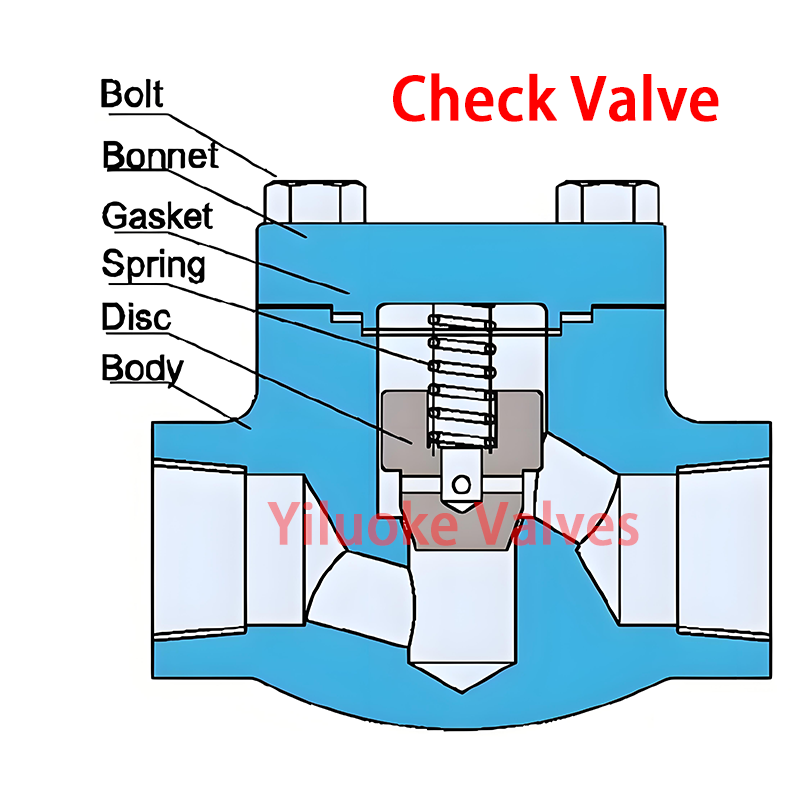
A check valve refers to a type of valve whose opening and closing part is a circular disc, which acts by its own weight and medium pressure to block the backflow of the medium. The content of the check valve selection criteria is as follows:
To prevent medium backflow, check valves should be installed on equipment, devices, and pipelines;
Check valves are generally suitable for clean media and should not be used for media containing solid particles or with high viscosity;
Generally, vertical lift check valves should be selected for horizontal pipelines with a nominal diameter of 50mm;
Straight-through lift check valves can be installed on both horizontal and vertical pipelines;
For water pump inlet pipelines, foot valves are preferred. Foot valves are generally only installed on vertical pipelines at the pump inlet, and the medium flows from bottom to top;
Lift check valves have better sealing performance than swing check valves but higher fluid resistance. Horizontal lift check valves should be installed on horizontal pipelines, and vertical lift check valves should be installed on vertical pipelines;
The installation position of swing check valves is not restricted. They can be installed on horizontal, vertical, or inclined pipelines. If installed on vertical pipelines, the medium flow direction must be from bottom to top;
Swing check valves are not suitable for being made into small-diameter valves, but can be made to withstand high working pressure with a PN up to 42MPa, and the DN can also be made very large, up to more than 2000mm. Depending on the materials of the shell and sealing parts, they can be applied to any working medium and any working temperature range. The medium includes water, steam, gas, corrosive medium, oil products, pharmaceuticals, etc. The working temperature range of the medium is between -196℃ and 800℃;
They are suitable for low-pressure and large-diameter occasions, and the installation occasions are restricted;
The installation position of butterfly check valves is not restricted. They can be installed on horizontal pipelines, as well as vertical or inclined pipelines;
Diaphragm check valves are suitable for pipelines prone to water hammer. The diaphragm can well eliminate the water hammer generated when the medium flows backward. They are generally used on low-pressure and normal-temperature pipelines, especially on tap water pipelines. The general working temperature of the medium is between -12℃ and 120℃, and the working pressure is 1.6MPa. However, diaphragm check valves can be made into large diameters, with the maximum DN up to more than 2000mm;
Ball check valves are suitable for medium and low-pressure pipelines and can be made into large diameters;
The shell material of ball check valves can be stainless steel, and the hollow ball of the sealing part can be wrapped with PTFE engineering plastic, so they can also be applied to pipelines with general corrosive media. The working temperature is between -101℃ and 150℃, the nominal pressure is ≤4.0MPa, and the nominal diameter range is 200—1200mm;
When selecting check valves for incompressible fluids, first evaluate the required closing speed, and the second step is to select the type of check valve that may meet the required closing speed;
When selecting check valves for compressible fluids, a similar method to that for incompressible fluids can be used. If the medium flow range is large, a deceleration device can be used for the check valve for compressible fluids. If the medium flow stops and starts continuously and quickly, such as at the outlet of a compressor, a lift check valve should be used;
The corresponding size of the check valve should be determined, and the valve supplier must provide the data of the selected size, so that the valve size when the valve is fully open at a given flow rate can be found;
For high and medium pressure check valves with DN below 50mm, vertical lift check valves and straight-through lift check valves are preferred;
For low-pressure check valves with DN below 50mm, butterfly check valves, vertical lift check valves, and diaphragm check valves are preferred;
For high and medium pressure check valves with DN greater than 50mm and less than 600mm, swing check valves are preferred;
For medium and low pressure check valves with DN greater than 200mm and less than 1200mm, wear-free ball check valves are preferred;
For low-pressure check valves with DN greater than 50mm and less than 2000mm, butterfly check valves and diaphragm check valves are preferred;
For pipelines requiring small or no water hammer impact when closing, slow-closing swing check valves and slow-closing butterfly check valves are preferred.
 What Are Creamic Lined Valves?
 How to Select High‑Pressure Ball Valves
 Gas Pressure Regulator Installation and Operation Instructions
 What is a Flowmeter?