


Common Accessories of Pneumatic Angle Seat Valve
Common Accessories of Pneumatic Angle Seat Valve: Functions and Usage
Pneumatic angle seat valves are widely used for frequent short-term start-ups, featuring quick response and precise action. When used with solenoid valves, pneumatic control can accurately regulate the cut-off and flow rate of gases and liquids. They can meet requirements such as precise on-off control, temperature control, and liquid dripping, and are extensively applied in numerous industries including food, brewing, beverages, dairy products, fine chemical pharmaceuticals, and bioengineering.
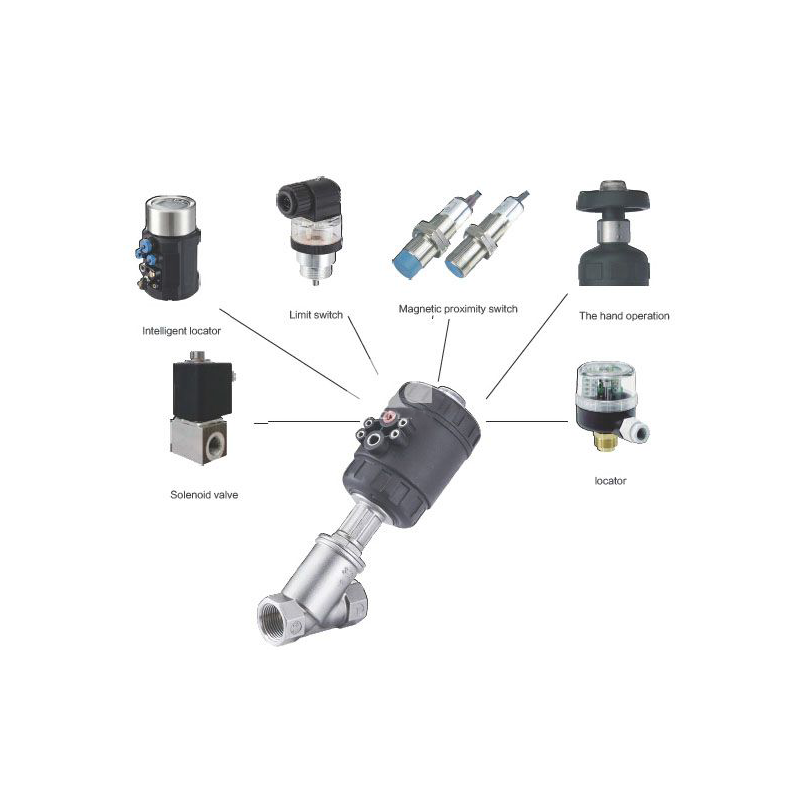
In the practical application of pneumatic angle seat valves, several accessories are required for coordinated use to achieve automatic control, such as solenoid valves, limit switches, positioners, air filter regulators, etc. Understanding and using the accessories of pneumatic angle seat valves is also important for operators. Now, we introduce several common types of accessories for pneumatic angle seat valves:
Stroke Limiter: Adjustable piston opening to regulate flow rate; equipped on all angle seat valves. It can also be used for emergency braking on single-acting normally open angle valves.
Emergency Manual Device: Used for emergency braking (no control air supply, mechanical failure, no control air supply signal).
Solenoid Valve: Directly installed with 3/2-way solenoid valve pilot; the valve body can be rotated 360°; 5/2-way valve can be converted to 3/2-way valve by rotating the base plate 180°; ambient temperature: -10℃~+50℃.
Limit Switch: Suitable for angle seat valves of all calibers; can be installed on the pneumatic control head to detect the open/close state of the valve; the terminal is connected to the solenoid valve, and an LED display is optional. Protection Class: IP65; Ambient Temperature: -10℃~+70℃; Threaded Interface: 2PG11; Material: Polyamide (Polycarbonate); Limit Switch Type: Inductive/Proximity/Mechanical.
Positioner: The valve positioner is the main accessory used to control and adjust the valve opening. It is used with pneumatic valves. It receives the output signal from the regulator and then uses its output signal to control the pneumatic valve. After the valve acts, the displacement of the valve stem is fed back to the valve positioner through mechanical devices, and the valve position status is transmitted to the upper system through electrical signals. As the most precise component in the entire control valve, the valve positioner also has the highest failure rate. Once a failure occurs, it will affect the operation of the entire system.
Air Filter Regulator: The function of the air filter is to filter moisture in the air supply. Since most air supplies are unpurified and contain moisture, which can damage solenoid valves, cylinders, and valves, it is necessary to connect an air filter to remove moisture before the air supply enters the valve. There are two types of filter regulators: automatic drainage and manual drainage. Automatic drainage has a higher cost but is easy to use; the filter is set with a volume where air pressure is proportional to moisture, and when the water volume reaches a certain level, automatic drainage is performed. Manual drainage requires manual drainage at least once a month. Generally, domestic models can be drained by pulling outward, while imported models can be drained by pressing inward.
 What Are Creamic Lined Valves?
 How to Select High‑Pressure Ball Valves
 Gas Pressure Regulator Installation and Operation Instructions
 What is a Flowmeter?