


Steel Valves VS Carbon Steel Valves
Differences Between Stainless Steel Valves and Carbon Steel Valves
Different Material Elements
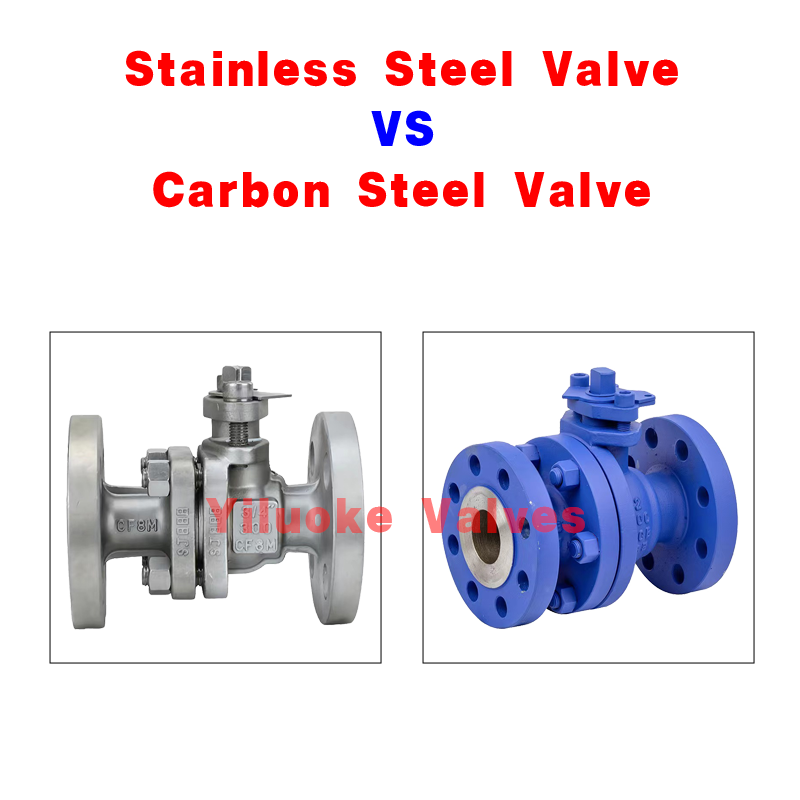
Common materials for stainless steel valves include CF8 (304), CF3 (304L), CF8M (316), CF3M (316L), 321, 1Cr18Ni9Ti, 0Cr18Ni9, 310S, 2250, and ordinary non-standard stainless steel materials such as 201. Letters like CF8, CF3, CF8M, and CF3M are casting codes, while numerical forms like 304 and 316 are forging codes. CF8 (304) is generally an American standard code, corresponding to the domestic code 0Cr18Ni9. 321 corresponds to 1Cr18Ni9Ti domestically.
The chemical composition of 304 stainless steel is generally: C ≤ 0.08, Mn ≤ 2.00, P ≤ 0.045, S ≤ 0.030, Si ≤ 1.00, Cr 18.0–20.0, Ni 8.0–11.0. The structural elements of 316 stainless steel are: C 0.03~0.08, Si ≤ 1.0, Mn ≤ 2.0, Cr 16.0–18.0, S ≤ 0.03, P ≤ 0.045, Mo 2.0–3.0, corresponding to the national standard grade 0Cr17Ni12Mo2.
The chemical elements of 321 stainless steel are as follows: C ≤ 0.08; Si ≤ 1.00; Mn ≤ 2.00; S ≤ 0.030; P ≤ 0.035; Cr 17.00~19.00; Ni 9.00~12.00; Ti ≥ 5×C%. 316L is an upgraded version of 316 with an increased nickel content, offering higher corrosion resistance.
310S corresponds to the grade 2520 (0Cr25Ni20), commonly known as duplex steel. It is a high-quality stainless steel material with excellent high-temperature resistance and corrosion resistance, and is relatively expensive. Its chemical composition is: C ≤ 0.08, Si ≤ 1.00, Mn ≤ 2.00, P ≤ 0.035, S ≤ 0.030, Ni 19.00-22.00, Cr 24.00-26.00.
Stainless steel valves and stainless steel materials have a wide range of applications, generally used in chemical plants, food factories, water supply plants, etc. They have excellent characteristics such as corrosion resistance, pressure resistance, high-temperature resistance, wear resistance, and cleanliness, making them indispensable valves and materials for industrial and civil use.
Common materials for carbon steel valves include carbon steel WCB cast steel, A105 forged steel, 20# steel, LCB low-temperature steel, etc. WCB carbon steel is the most commonly used; WCB cast steel valves play a vital role in daily life and industrial pipelines with extensive usage.
A105 material is produced by forging process, featuring good tensile strength, high material density, high-pressure resistance, and high-temperature resistance, suitable for use in small pipelines. 20# steel is generally used for accessories, usually in the form of bars such as bolts and nuts. LCB is low-temperature carbon steel, used in low-temperature working conditions such as cold storage pipelines.
The chemical composition of WCB material is: C ≤ 0.3, Mn ≤ 1.0, Si ≤ 0.6, P ≤ 0.05, S ≤ 0.06, Ni ≤ 0.5, Cr ≤ 0.4, Mo ≤ 0.25. The chemical composition of A105 forged steel material differs from casting materials: C ≤ 0.35, Si ≤ 0.35, Mn 0.6-1.05, S ≤ 0.050, P ≤ 0.040. The chemical composition of LCB low-temperature carbon steel is: C ≤ 0.30, Si ≤ 0.60, Mn ≤ 1.0; for LC3 (-101℃), C ≤ 0.15, Mn 3.0~4.0.
Characteristics and Application Fields of Stainless Steel Valves and Carbon Steel Valves
Stainless steel valves perform well in both corrosive pipelines and steam pipelines, with characteristics of corrosion resistance, high-temperature resistance, and high-pressure resistance. They are generally used in corrosive pipelines of chemical plants, as well as pipelines of water supply plants or food factories.
Carbon steel valves, however, do not have corrosion resistance and can only be used in pipelines carrying non-corrosive media such as steam, oil products, and water. The cost of carbon steel valves is much lower than that of stainless steel valves.
 What Are Creamic Lined Valves?
 How to Select High‑Pressure Ball Valves
 Gas Pressure Regulator Installation and Operation Instructions
 What is a Flowmeter?