


What is a 5-Valve Manifold?
Five-Valve Manifold: Composition, Functions, Operation Procedures, Precautions & Troubleshooting
The correct use of the five-valve manifold is crucial for the safety of industrial processes and measurement accuracy.
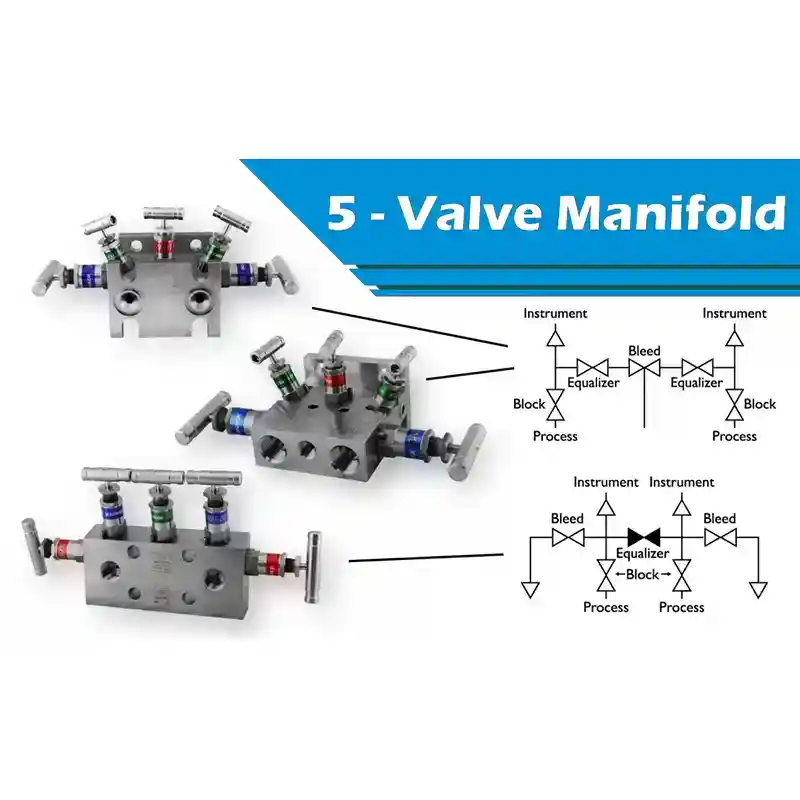
1. Composition
A typical five-valve manifold consists of the following valves:
High-pressure side globe valve (1 piece): Connects to the high-pressure side process pipeline.
Low-pressure side globe valve (1 piece): Connects to the low-pressure side process pipeline.
Balance valve (1 piece): Connects the high-pressure and low-pressure sides for pressure balancing.
High-pressure side blowdown/vent valve (1 piece): Used for pressure relief or cleaning of the high-pressure side pipeline.
Low-pressure side blowdown/vent valve (1 piece): Used for pressure relief or cleaning of the low-pressure side pipeline.
2. Main Functions
Instrument isolation: Cuts off process media during maintenance or calibration.
Pressure balancing: Prevents differential pressure transmitters from bearing one-way overload during startup and shutdown.
Blowdown/venting: Removes impurities or gas in the pipeline to ensure measurement accuracy.
3. Operation Procedures
3.1 Normal Commissioning Process
Initial state:
High-pressure valve and low-pressure valve: Closed.
Balance valve: Open (to avoid impact on the transmitter).
Blowdown valves: Closed.
Open high-pressure and low-pressure valves: Slowly open the high-pressure and low-pressure valves to fill the measurement pipeline with media.
Close the balance valve: After confirming pressure stabilization, close the balance valve. The transmitter starts normal differential pressure measurement.
3.2 Shutdown or Maintenance Process
Open the balance valve: First open the balance valve to equalize the pressure on the high-pressure and low-pressure sides.
Close high-pressure and low-pressure valves: Cut off the process media.
Blowdown/venting (if required): Slowly open the blowdown valve to discharge residual media (note protection).
4. Precautions
Operation sequence: Incorrect sequence may cause overload damage to the transmitter!
Commissioning: First open the balance valve → then open the high-pressure and low-pressure valves → finally close the balance valve.
Shutdown: First open the balance valve → then close the high-pressure and low-pressure valves.
Valve operation speed: Open and close valves slowly to avoid pressure sudden changes impacting the transmitter diaphragm.
Blowdown operation: Ensure the process system allows pressure relief and wear protective equipment. Avoid media splashing (special caution for high-temperature, corrosive or toxic media).
Leakage inspection: Regularly check valve tightness, especially internal leakage of the balance valve which may cause measurement errors.
Regular maintenance: Clean impurities in the valve manifold to prevent blockage; lubricate the valve stem (if required).
Instrument calibration or zero calibration: Close the high-pressure and low-pressure side isolation valves to cut off the process media. Open the balance valve to equalize the pressure on both sides of the transmitter (differential pressure is zero). Perform zero calibration operation. After calibration, close the balance valve and re-open the high-pressure and low-pressure isolation valves.
5. Troubleshooting Common Problems
Abnormal transmitter display: Check if the balance valve is fully closed or if there is internal valve leakage.
Pipeline blockage: Flush through the blowdown valve; disassemble and clean if necessary.
Valve jamming: Do not force operation; disassembly, maintenance or replacement is required.
No instrument display: Check if all valves are fully open and the balance valve is closed.
Large measurement deviation: May be due to the balance valve not being fully closed or internal valve leakage.
Leakage: Tighten the valve stem or replace the seal.
 What Are Creamic Lined Valves?
 How to Select High‑Pressure Ball Valves
 Gas Pressure Regulator Installation and Operation Instructions
 What is a Flowmeter?