


What Are High Vacuum Gate Valves?
High Vacuum Gate Valve: Working Principle, Applications, Installation & Maintenance
The working principle of the High Vacuum Gate Valve is to control the gate valve connected to the pipeline to block or connect the medium in the pipeline. Vacuum valves are used to protect vacuum pumps and serve as a shunt guide function for air extraction. In various vacuum automatic production lines, they are used to control gas flow, realizing precise process control of connecting or cutting off pipeline circulation on the pipeline. Common vacuum gate valves in the industry can be divided into two types: High Vacuum Gate Valves and Ultra-High Vacuum Gate Valves.
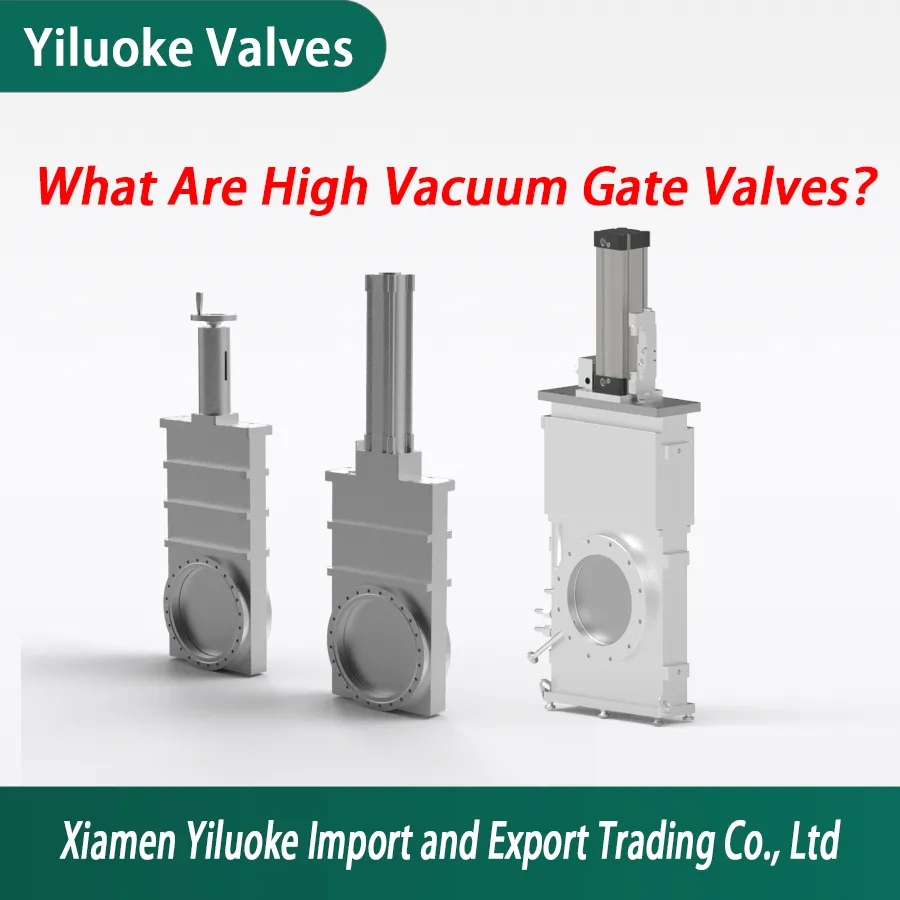
Working Principle of High Vacuum Gate Valve
The High Vacuum Gate Valve is driven by a screw (manual and electric) or a cylinder rod (pneumatic). Under the axial movement of the sealing shaft, it pushes (pulls) the link mechanism, thereby driving the valve core assembly to move axially. When the limit block on the valve core assembly moves to the end, the sealing plate and the support plate stop axial movement. At this time, the sealing plate and the support plate are concentric with the outer flange hole. If the valve core assembly continues to be pushed, the steel balls located in the steel ball grooves of the sealing plate and the support plate are gradually pushed out by the valve core assembly, so that the sealing plate and the support plate are expanded by the steel balls and pressed against the sealing surface and support surface of the flange respectively.
When the steel balls completely leave the grooves and are located on the planes of the sealing plate and the support plate, the pressing force reaches the maximum, and the High Vacuum Gate Valve is completely closed. Under the action of the fluororubber sealing ring, the required sealing effect is achieved. When the valve core assembly is pulled to move backward, due to the large friction between the sealing plate, the support plate and the flange surface, the steel balls are first pulled back into the steel ball grooves of the sealing plate and the support plate. Under the action of the spring sheet, the sealing plate and the support plate leave the sealing surface and support surface of the flange, press the steel balls into the steel ball grooves again, and the entire valve core assembly moves backward together under the drive of the link mechanism, leaving the flange orifice, so that the High Vacuum Gate Valve is completely opened.
Applications & Applicability of High Vacuum Gate Valve
The High Vacuum Gate Valve is one of the important components in the vacuum system. It can be used as an opening and closing mechanism in the vacuum pipeline.
Cohenke High Vacuum Gate Valve is suitable for occasions where the working medium is air and non-corrosive gases.
Features of High Vacuum Gate Valve
High reliability
Excellent sealing performance
Ultra-low outgassing rate
Stable operation
Low noise and vibration
Easy installation
Compact structure
Elegant and generous appearance
Installation & Usage of High Vacuum Gate Valve
Before installation, the main components of the valve should be inspected:
Check for damage during transportation.
No scratches, spots, etc. are allowed on all sealing surfaces and knife edges.
Check whether the cavity and connecting surface are clean and ensure they meet vacuum hygiene requirements.
Inspect the valve's drive mechanism, such as: whether the transmission screw of the manual valve rotates flexibly; whether the solenoid directional valve of the pneumatic valve can switch direction freely, and whether the piston movement is flexible and reliable.
After maintenance and assembly, the valve should be inspected for vacuum hygiene and vacuum sealing performance. It can be installed into the system only after passing the inspection.
Maintenance of High Vacuum Gate Valve
Attention should be paid to maintenance during transportation and storage to improve its service life:
The gate valve should always be kept clean and hygienic, and stored in a dry indoor place.
When the gate valve is not used for a long time, attention should be paid to protecting all sealing surfaces, and all flanges must be covered with plastic caps; when not used for a long time, the valve should be in an open state to avoid long-term compression deformation of the fluororubber ring, which will affect the service life.
During transportation, the gate valve should be in a closed state to avoid deformation of internal parts due to vibration, which will affect transmission and sealing.
Precautions for Using High Vacuum Gate Valve
The gate valve is a thin-shell device. Do not subject it to external pressure or impact. During installation, do not use the valve body as a load-bearing body to avoid deformation of the shell due to load-bearing, resulting in the valve being unable to open or close, which will affect its use and sealing performance.
When the gate valve is started again after being placed for a long time, the valve plate may not open due to adhesion between the sealing ring and the sealing surface, which is especially serious for pneumatic valves. At this time, the solenoid directional valve can be set to the valve opening state, and the valve plate can be gently tapped from the front to open the valve before being installed into the system for use.
In principle, the gate valve should be opened under the condition of balanced air pressure on both sides of the valve; otherwise, the valve cannot be opened. Forcing the valve to open may easily damage the sealing ring and transmission mechanism.
The High Vacuum Gate Valve is best installed horizontally, with the sealing plate facing the high vacuum end of the system; or installed vertically with the drive part upward. Avoid vertical installation with the drive part downward as much as possible, especially for pneumatic valves, to prevent the valve plate from rebounding when closing, failing to lock in the normal sealing position, resulting in the valve being unable to close or seal tightly.
 What Are Creamic Lined Valves?
 How to Select High‑Pressure Ball Valves
 Gas Pressure Regulator Installation and Operation Instructions
 What is a Flowmeter?