


What is a 2-way Valve Manifold?
1. What is a 2-way Valve Manifold?
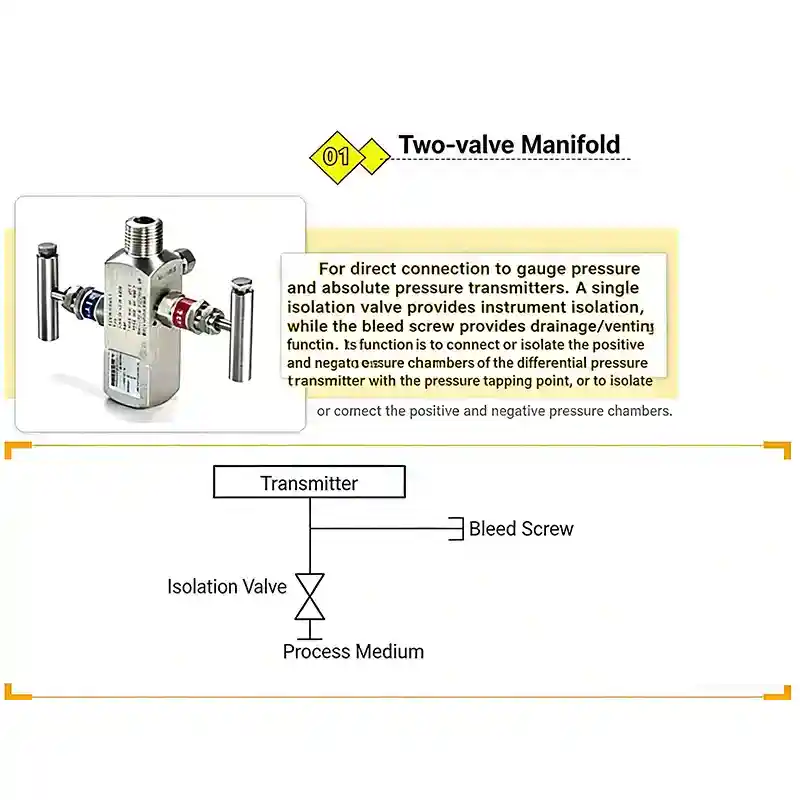
A 2-way valve manifold is a valve assembly device used in conjunction with instruments such as pressure transmitters and differential pressure transmitters in industrial automation control systems. It features two globe valves as core components. Its main function is to connect or disconnect the instrument's pressure chamber from the pressure tapping point by operating the valves. It also has auxiliary functions including on-line calibration, blowdown and flushing, which can effectively reduce system downtime for maintenance . The device adopts threaded connection (1/2NPT, 1/4NPT and other specifications), is compatible with φ12-φ18 pipeline systems, and is widely used in pressure detection systems in petrochemical, power energy, pharmaceutical and other fields.
2. Structural Characteristics
Non-rotating valve stem tip design: Forms a tapered sealing structure between the valve seat and valve core to effectively prevent medium leakage.
Integrated dual independent valves:
Globe valve: Controls the on-off of the medium, using stainless steel needle valves for precise flow regulation.
Drain valve: Equipped with a test port for instrument calibration and serves as a blowdown channel.
Compact structure (partial models): Designed to fit limited installation spaces.
3. Functions
Pressure chamber control (achieved by opening and closing the globe valve):
Establishes the pressure transmission path required for instrument measurement in the connected state.
Isolates the transmitter from the process pipeline in the closed state.
On-line maintenance (without disassembling the instrument):
Performs system blowdown by operating the drain valve.
Connects calibration equipment to conduct instrument calibration.
System protection: Can quickly cut off medium flow under emergency conditions to prevent instrument damage due to overload.
4. Technical Parameters
Parameter Name | Specifications |
|---|---|
Connection Method | Threaded connection (1/2NPT, 1/4NPT, etc.) |
Flow Aperture | DN6-DN25 specification series [1] |
Seal Test | 1.5 times the rated pressure with no leakage under pressure holding |
Surface Treatment | Nickel plating/epoxy coating anti-corrosion process |
Execution Standard | Complies with ASME B16.34 valve specifications |
5. Application Fields
It plays an irreplaceable role in the following industrial scenarios:
Oil and gas: Supporting wellhead pressure monitoring systems
Chemical production: Reactor pressure interlock control systems [2]
Power and heating: Boiler drum liquid level measurement devices
Pharmaceutical industry: Cleanroom pressure gradient control systems
 What Are Creamic Lined Valves?
 How to Select High‑Pressure Ball Valves
 Gas Pressure Regulator Installation and Operation Instructions
 What is a Flowmeter?