


Working Principle of Pressure Self-sealing Valves
Valve Sealing Forms: Focus on Pressure Self-sealing
Valve sealing forms are mainly divided into two types. One is forced sealing, which relies on the middle flange bolts to apply pressing force to the gasket to achieve valve sealing. What we mainly talk about today is the other sealing form, namely pressure self-sealing. An initial sealing condition is formed between the valve body and the sealing ring. Pressure self-sealing valves are widely used in high-demand fields, such as petrochemical, natural gas, aerospace, nuclear power plants, etc. With the continuous improvement of requirements for safety performance and service life, pressure self-sealing valves have become one of the important switching devices in these fields. At the same time, under some special working conditions, pressure self-sealing valves can exert better performance, such as anti-leakage of low-pressure long pipelines, control of toxic and flammable media, etc.
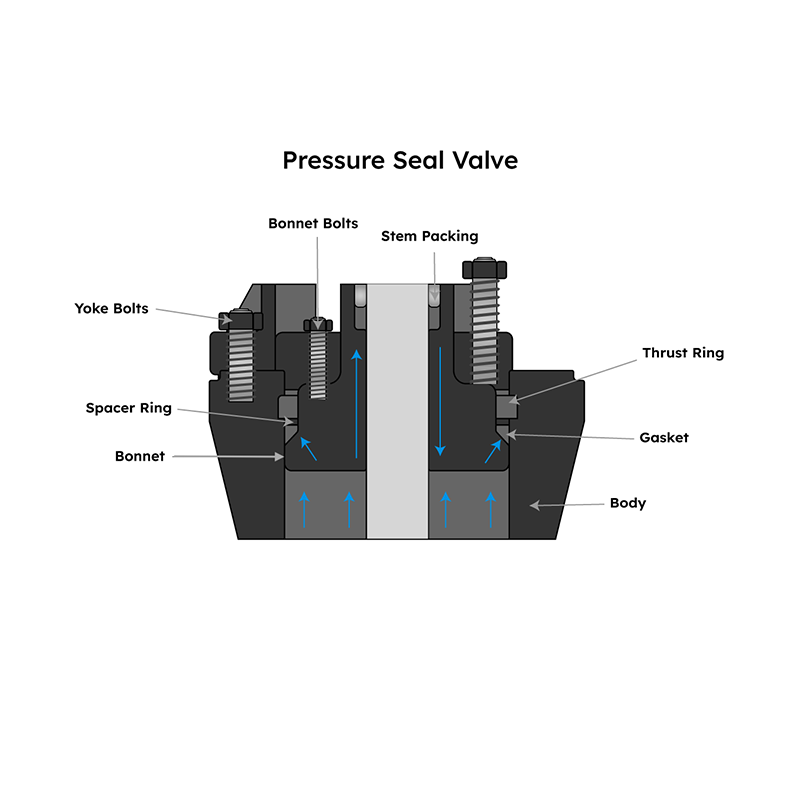
Working Principle of Pressure Self-sealing Valves
Before the pressure of the pressure self-sealing valve rises, first tighten the bolts to lift the valve cover, so as to form the initial sealing condition between the valve cover and the wedge-shaped gasket, as well as between the valve body and the wedge-shaped gasket—the preload specific pressure on the sealing surface. When the medium pressure rises, the sealing specific pressure between the valve cover and the wedge-shaped gasket, and between the valve body and the wedge-shaped gasket gradually increases with the increase of pressure. In pressure self-sealing, the working sealing specific pressure on the sealing surface is composed of two parts: one is the preload sealing specific pressure, and the other is the specific pressure formed by the medium pressure. It should be emphasized that in pressure self-sealing, the medium pressure always tends to increase the preload sealing specific pressure and improve the sealing performance. The higher the medium pressure, the greater the working sealing specific pressure and the better the sealing performance. Based on this characteristic, pressure self-sealing, as a high-pressure sealing technology, is often used in high-temperature, high-pressure and large-diameter valves.
Features & Applications of Pressure Self-sealing Valves
Core Features
In terms of working performance, within the working pressure range of pressure self-sealing valves, the higher the pressure, the better the sealing performance.
The working principle of pressure self-sealing valves mainly relies on the principle that the wedge-shaped sealing surface is sealed under pressure, so the higher the pressure, the better the sealing effect. Of course, this pressure must be within the bearing range of the seal. Although the sealing principle is roughly similar, the sealing structure and seal material have different changes to adapt to different working conditions and different preload requirements (preload is usually applied through a bolt structure and can be adjusted).
Application Scope
The pressure self-sealing structure is widely used in the upper sealing of valves, mainly in working conditions above 900LB.
Classification by Force Direction of Medium Pressure
According to the direction of the force exerted by the medium pressure on the gasket, pressure self-sealing can be divided into: axial self-sealing and radial self-sealing.
Axial self-sealing includes:
Wedge gasket combined sealing (Wood sealing)
Wedge sealing
Flat gasket self-sealing
C-ring sealing
O-ring sealing
Radial self-sealing includes:
Double cone sealing
B-ring sealing
Triangle gasket sealing
Octagonal gasket (elliptical gasket) sealing
Lens gasket sealing
 What Are Creamic Lined Valves?
 How to Select High‑Pressure Ball Valves
 Gas Pressure Regulator Installation and Operation Instructions
 What is a Flowmeter?